
FINDESTE
A fantasy world
Welcome to Findeste! My name is Juan, a.k.a. Itegami, and I will be your guide to this wonderful world I've created. Care to dive in?
What is Findeste?
Findeste is an original fantasy world created by myself after months of fine-tuning this vague area I'd use for generic fantasy RP's into a fully-fleshed out world fit for any roleplay setting or Dungeons and Dragons game. As I do play D&D 5th Edition, a lot of elements in this whole world are inspired by that game's mechanics, as well as being inspired by things from popular media such as My Hero Academia, RWBY, Wizard101, Avatar: The Last Airbender, and plenty of other similar things. It's just a hodge-podge of concepts I like from shows and games thrown into one setting.I urge anyone who takes the time to come to this website to read it all when you can - maybe not all at once, but in segments. This is an ever-growing project, constantly in development for the foreseeable future to be improved upon and expanded. If this is a setting you'd want to use for your OWN campaigns or roleplays, you're more than welcome to! Just make sure to credit me and any custom art you see me post on here, as it's all artwork I commissioned and payed for.
Below here are a couple of buttons to help you navigate along the way.
- "To Mechanics" will take you to some pages that will teach you about the basic things you'd need to know about the world. Calendar, language, all those little things that are so common that they shouldn't be confusing.
- "History" will take you through the history of the world that led up to its "present time" setting that most roleplays will likely be taking place in.
- "Ambies" will take you to a spot to discuss the main "gimmick" of this world, Ambiguities, and how they make this world different from other fantasy worlds.
- "Setting" will take you through the world itself; various maps along with guides to everything you need to know about the countries and cities that fill up this massive world.
- "My RP Carrd" is just a link to my personal Carrd for roleplay, so you can always check out my muses and OC's for potential interaction with me.
- My Homebrew Carrd is a link to my other Carrd, where I put tons of D&D 5e homebrew things I create. It includes things like new classes and items to new races that are actually present in this world! Might be worth a good read if you want to use or participate in a Findeste-setting campaign.Now dive in and explore this rich world I'm making for you!
The World of Findeste
(Political Map)

This is the political map of Findeste. It's composed of 10 countries that are all neatly organized and such, and each one has its own unique aspects to it. You can use the following buttons to navigate through every single country on its own to learn more about them.NOTE: I am using a map generated from Azgaar's Fantasy Map Generator for this map of Findeste. Not every single aspect from the interactive map will be present in the final representation of Findeste, SO if you request access to the .map file so you can interact with the map yourself, not every option will be 1-to-1 with what I am putting on here.
Donvidia
(A Land of Orcs and Tribes)

Donvidia is an archipelago country, full of various different cultures and tribes across the islands represented by the grayish color. It's less of a proper kingdom (contrary to the name) and more of a cultural land, being full of 90% orcs and orc variant races. The different orcs that live across these islands have developed many types of cultures, so nearly every island set has its own unique customs and societies when compares to the others. With inspirations of ancient Mongolia in the north, Polynesia towards the center of the world, and more Inuit inspirations to the south, Donvidia has a wide range of cultures across its islands.
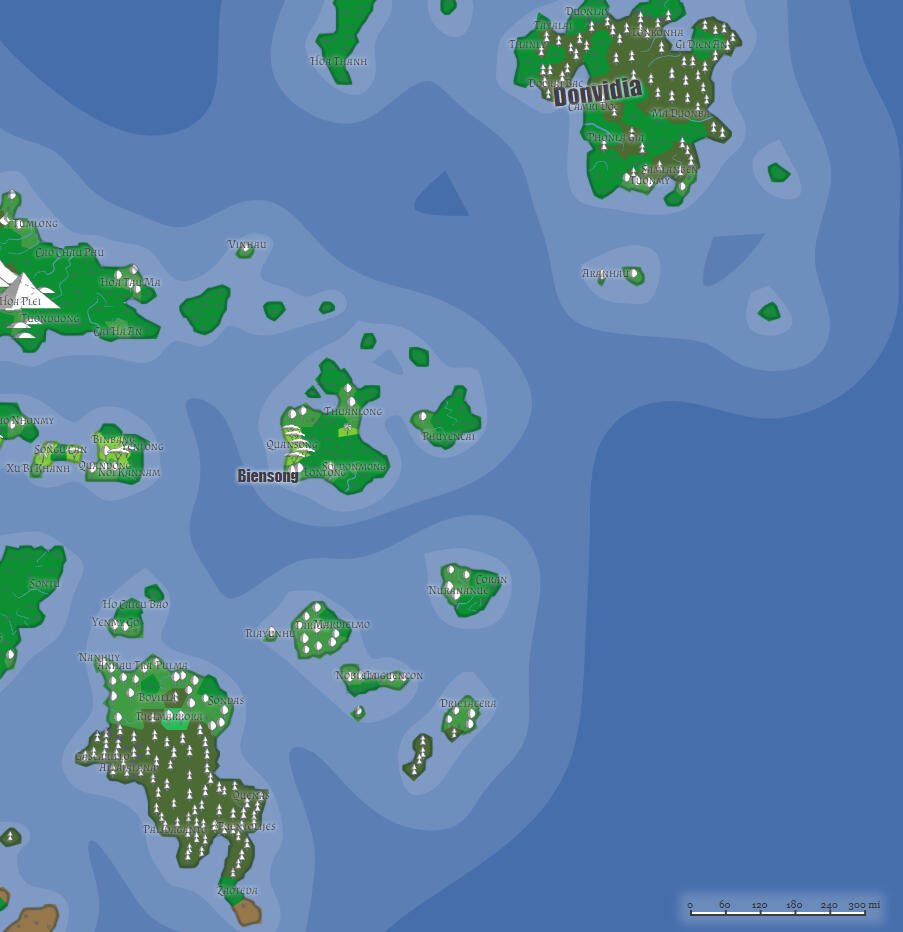
Considering that Donvidia spreads across the whole latitude of Findeste, some islands have wildly different climates to others. The far north and south are cold, snowy regions full of Tundra or Temperate Deciduous Forests, whereas the islands towards the middle of the world are more Coniferous Forests with even some small Savannahs and Tropical Rainforests in those more yellowish regions.
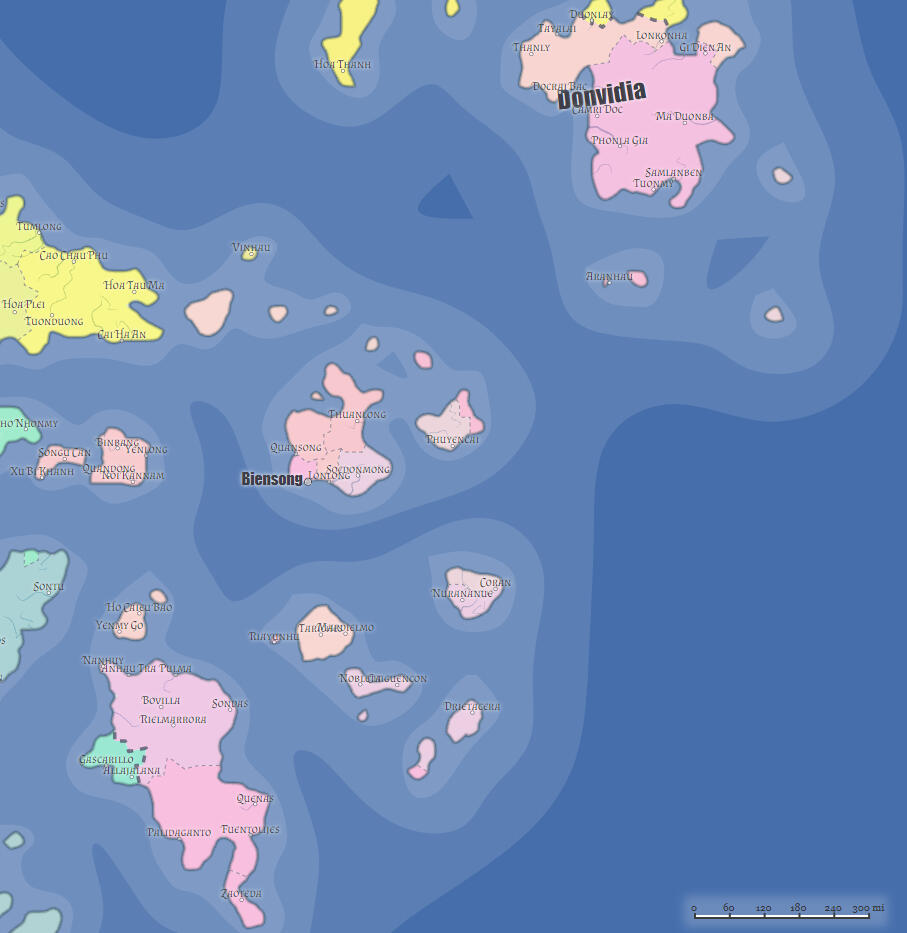
There's a WHOLE LOT to unpack here, so let's take it one step at a time by focusing on the regions.First we have the northern islands closest to Traidral. These consist of the main island bordering Traidral and a few supplementary islands. The main island is split in two, the northern parts being Loncaia County and the southern, larger part being Tuonmy County. The two islands to the southeast are the Caiditamia Islands, while the two just south are the main part of the Aranhau Colony, which does stretch to the southwest a bit with an island and part of the land where the city of Phuyenchi is. These areas are based on ancient Mongol society, focused on strength of clan as your social hierarchy, and it follows a very patriarchal line as well. The man that runs it is a powerful orc named Kar'sorro Khan, and his family has been the dominant clan around these northern islands of Donvidia for centuries at this point. His family united the other clans through promise of riches and glory, making their island the superior of the orc tribes across Donvidia and being a threat against Traidral, who seeks to colonize their land. He and his vassals keep order among the working class across these islands and use the more southern parts of Aranhau Colony to do trade with those in the central islands of Donvidia.Speaking of the central islands of Donvidia, these are in a much warmer climate, and they're inspired by some Asian and Polynesian customs/society. It's another tribal society where rather than a singular main tribe uniting the smaller ones, the main island consists of five regions for the four major sub-tribes, whose names share the regions of that main island: Biensong, Lonlong, Quanlong, Thuanlong, and Socdonmong Landgraves. Unofficially speaking, Biensong is seen as the "leader" of these five tribes, hence why the title city is seen as the capital of Donvidia. Just to the northwest of Thaunlong (and south of the Traidral island of Vinhau) are two islands known as the Yendecia Islands, which hold the Yendecia Tribe, a smaller tribe that descended from the Thuanlong (maintaining good relations with them). The rest of those small islands in that chain are part of Aranhau.
Going even more specific, the buttons below will take you to maps and details of certain cities of any interest within the given country.
Traidral
(A Feudal Land)

Traidral is a very oriental-styled country, far north in Findeste with plenty of coast access. It's heavily based on the Kara-Tur lore from Dungeons and Dragons, which itself is based on medieval time periods of Eastern Asia. You'll mostly find inspirations of feudal Japan, with bits of historical China and Mongolia in certain areas. You can see all parts of it in the yellowish colors, and how it has a mainland and a few colonies away via the ocean.

North means cold, and cold means Taiga biomes, represented by that darkest green color across Traidral. There are mountains within Traidral (not just at the border with Netrodino), which accounts for the white spot of Glacier and the reddish-brown spot of Tundra there in the center. Most of the rest of Traidral is Wetlands, shown by the next shade of green down from Taiga. There's a couple spots of Temperate Rainforest thrown around as the next shade down, and there's the tiny patches of Grassland in that cream color towards the Traidral/Dreila border.A lot of the mainland of Traidral is well above sea level, the average being about 1500 feet above sea level. Going into their mountains puts the average around 4000 feet, and while not quite as grand as the Netrodino mountains, the highest peaks reach a respectable 7000+ miles high above sea level. Most of the land where natural vegetation can grow is towards the shores and such, but the mountainous areas still fit the environments they're in. Lots of them have carved paths (made naturally and with man-made work) so that people and cities can move through and live in these mountains.

There's a WHOLE LOT to unpack here, so let's take it one step at a time. First thing's first, Traidral is set up in a shogunate type of system, heavily based on the Edo system in feudal Japan. The Emperor rules from the county's capital of Traidral (often just called "Traidral City" to differentiate) while the shogun rules from Sebeste. The Emperor rules over the country of Traidral with the shogun, focusing on cultural matters topping the society's hierarchy. Beneath him are the court nobility, followed by the shogun, who handles Traidral's militaristic affairs. The shogun assigned the daimyo to rule as military leaders of their respective regions of the country, and the rest of the social hierarchy follows the 4 Paths of the People: samurai in fifth place, farmers in sixth (and being the first of the commoners), artisans in seventh, and merchants in eighth. The bottom of the barrel were the Hamlets, those whose jobs (while mostly necessary) were tainted by death or sinful activities.As for the regions, let's start with the outlying ones (those not part of the mainland). The majority of the regions here are filled with humans, orcs, sea elves, and their Ambi race variants. To the northwest of the mainland are two islands and a chunk of land bordering Netrodino. This is the Soper Territory, ruled by the daimyo Anzai Osamu, a half-elf (wood elf lineage) samurai loyal to the emperor more than the shogun. The Anzai family is notable for having a good relationship with the wood elves of Netrodino, so most diplomatic events between them take place in Soper Territory.The next notable island is Vinhau Island. The daimyo of this small island is Hoshino Yori, a tiefling woman who took the place of her husband after he met an untimely end due to illness. She remains loyal to the shogun, despite her husband having been more loyal to the emperor. Vinhau, while a small island, is very important due to being a sort of "factory island", a lot of the country's best artisans coming from there and working there to export non-consumable goods to the rest of Traidral. Ruling over this small land and hardworking men and women is Hoshino's duty, and she takes great pride in this duty.Just to the north-northeast of Vinhau is the Motbuon Colony, taking up that large and smaller island together. The daimyo here is Gima Takayuki, a Swiftstride Shifter man who appears to stay loyal to the shogun. He is from the islands' original inhabitants of shifters, so while the mainland originally colonized here in the past, relations between the pure humans and shifters aren't particularly bad (at least on the surface).Just east of Motbuon is Duonlay Colony, a remnant of human-conquered land from before the Final Gambit. It has a high orc and tiefling population, and its daimyo is the half-orc Kobe Takeo, who is loyal to the emperor. A notable detail about Duonlay is that it's one of the only places you'll find half-oni communities, those children of tiefling and orc that inherit the Devil's Ambi to become like famed legendary monsters. Most of them become Hamlets due to their nature being highly disliked among Traidral society, tieflings less so based on their lineage.Continuing on with the mainland, the first territory is at the far west, just below Soper Territory is the Larisia Territory. While there's no official cities on the map, there's actually a major entrance to the underground cities of the Drow, so out of respect, the humans of Traidral (while owning the land on the surface) keep that area safe from trespassers that would interfere with the drow. In return, the drow often do trade with Traidral humans there. The shogun himself watches over this area as it is right next to Rolia County, the county in which the shogun himself resides. His name is Machida Katsumi, an aasimar man, and he rules out of the city of Murion over Rolia County and the Larisia Territory. Machida is often referred to as the "Kaminoikari", or "divine wrath of god", being seen as an angel sent by the great six gods to keep Traidral in check to not let them get so far as to cause another Final Gambit.Just south of Rolia is the Musia Clan, a historic region said to be home to the original founders of Traidral, the Musia family. The land is also overseen by the shogun and other samurai at his command, and the only people that travel or live through this land are patrolling samurai and a few families said to be direct descendants of the Musia clan of old.Directly east of the Rolia County is Huerralfor County, ruled over by daimyo Uyehara Shoji, a human man who's directly overseen and loyal to the shogun, willingly so. The Uyehara and Machida families have been close allies for centuries past, so the two closely match in their views and ideals. It's not too much of a stretch to say that Huerralfor County is just another extension of Rolia County.Just south of Huerralfor is Gascaza Earldom. It is called as such due to being a sort of mleting pot of multiple races and customs, similar to the Inernantian Empire itself. It also has an impressive embassy for the Empire (to essentially keep tabs on Traidral). It is ruled by the daimyo Miyake Tetsuo, an earth genasi man, and the Empire embassador is an air genasi woman named Curella Regulus, the two almost battling for influence over this region. There's not much the shogun can do since the emperor has invited them here after meetings with the royalty of the Empire, so this region is fully in support of the Emperor of Traidral despite Miyake being a shogun loyalist.Just east of Huerralfor is Estejosia County, where the capital city of Traidral is, where the Emperor lives. Emperor Ohta Mari is a human man whose family has served as Emperor for over 300 years at this point, and Estejosia is seen as the largest cultural center for Traidral. Plenty of farms and merchants that export goods to the rest of Findeste are found here, and they make for a great tourism spot for those visiting Traidral. To the south and southeast of Estejosia are the Bandienia County and Cai Ha An Territoy respectfully, ruled by a brother and sister daimyo. Fukahara Tatsuo and Fukahara Kimiko are an aarakocra and kenku respectively, and their family is known for their bird-like Animal Ambi inheritance over centuries. It is said that in the Fukahara family, the men's ferocity and swiftness made them into flying birds while the women's cunning and intelligence turned them into the flightless tricksters that are kenku. Luckily for the Emperor, the entirety of the Fukahara family has been loyal to the Ohta family for centuries, leaving them to be favoring the emperor over the shogun.
Going even more specific, the buttons below will take you to maps and details of certain cities of any interest within the given country.
Netrodino
(Land of the Wood Elves)

Netrodino is a very LONG and large country, primarily made up of wood elves, wood elf variants from Ambies, sea elves in the warmer climates, half-elves, and the occasional drow or so if you look in the right place. While not quite as much of an "elf Mecca" as Melia is, it's still a plenty diverse country whose main focus is on the history of wood elves.

There's a LOT to unpack here, so let's take it step-by-step. Netrodino is a very large country with various climates, ad as such, the types of elves you'll find will vary based on them, even just differences in skin tone among wood elves will change based on the environment they're in.The yellow strip of land running through the lower section of Netrodino is Tropical Seasonal Forest, and the darker shade of yellow just west by the city of Dubiostabla is Tropical Rainforest. These are the hottest areas of Netrodino by far. Starting with the greens (from lightest shade to darkest shade), we have Temperate Deciduous Forests, Temperate Rainforests, Wetlands, and Taigas. The Taigas are certainly fitting colder areas, hence why you only see them on the northernmost parts of Netrodino and towards the Traidral border. The brown bits on the northern parts of Netrodino are Tundra, and the white parts are pure Glacier.Going back to the area on the Traidral border, this area has various tall mountains and much higher altitudes, and it has a much colder climate because of it. While there's some simple Grassland as the cream-colored areas leading to the bits of taiga around there. The tan-colored bit are Cold Desert, and there's even some glacier areas at the peaks of the mountains. As you can see, Netrodino is a host to many different climates with many different kinds of sentient beings to inhabit it all over.
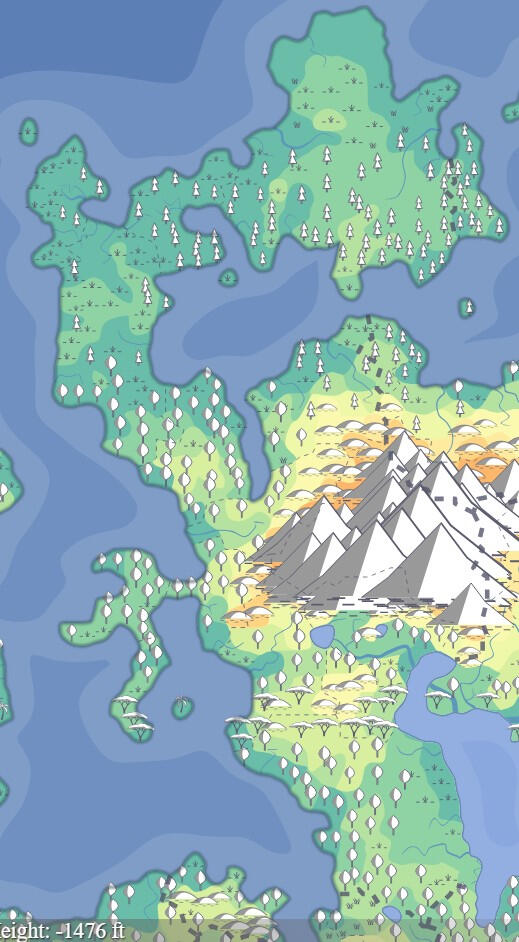
Most of Netrodino is fairly high above sea level. The green areas cap out at around 500 feet above sea level in the lighter green areas, but the yellow that makes up the average is about 1500 feet. Going into the Spines of the Arc, the mountain range that spans the Netrodino/Traidral border, the average height varies between 4000 and 7000 feet, the tallest peaks reaching just over 9000.You can also see all the varying forms of trees out there, from the tropical breeds down that center Equator-like line of hot climates to the deciduous trees that take up most of the southern areas, and even all the conifer trees that take up the colder, northern areas of Netrodino.

There's a WHOLE LOT to unpack here, so let's take it one step at a time. First thing's first, Netrodino is an oligarchy, each of its 16 districts being run by a prominent wood elf family from said district. They all convene twice a year in the capitol, Ponterelo, in what's known as The Council of Vibrios, named after the Goddess of Life Ambies and founder of all sentient life on Findeste. We'll be starting from the northmost point of Netrodino and working out way south to go through all of these areas.The northeastern point of Netrodino is Negra District. It's run out of the city of Negra by Duke Jassin Sagemire of Negra, a wood elf accustomed to the colder climates up that far north. Proceeding west from there, the Reykkafjor Territory is next, which includes the land connecting to Negra District and that northwestern corner (two parts of the same whole). That area is run out of its title city by Duke Beldroff Balfvale of Reykkafjor, a half wood elf with close ties to Walden as these two areas conversed regularly with trade and culture sharing.The next area that's just south of Reykkajfor is Zaklenai Deanery, run out of its title city by Duchess Dherrandah Camorock of Zaklenai, a wood elf woman who's best known for her family's antique exporting business. Next south is Rhorintia District, ruled out of Epia by Duke Triokan Bluepool. He is half wood elf and half sea elf, and his family is very mixed with sea elves in the bloodlines, so his stances usually take in mind some of the small sea elf population in Netrodino at heart when deliberating on policies.Directly east from there is the Mesand District, ruled by Duke Oslarelar Greenrock out of Tirapus. The district just south that connects Mesand to Rhorintia is the Avome Parish, run out of Typethum by Duke Vander Elmpool. Nothing is immdiately significant about neither the counties not their rulers, but the Greenrock and Elmpool families are still popular and powerful among Netrodino's history.Going south and west from there are the next three districts: Roliediori Deanery, Lelia Deanery, and Rodumia Deanery. They are ruled by the duchesses Henrah Shadymire, Eldratha Pineblossom, and Yghiilra Pineval respectively. These counties all have strong relations with Caltaurum and the other countries across from the Bay of Narrows. The same holds true for the next two districts: Palaria Island, which is ruled out of Dubiostabla by Duchess Yrneha Springscrub, and the Pontidia Deanery, the main county ruled from the capitol of Ponterelo by Duke Kusric Roserun. These 5 areas all have most of the communications with the Empire and Coastal Findeste through sea traffic.South of Mesand District, along the Netrodino/Traidral border, is the Cascanara Territory, run by Duke Ithraides Redfox. because of this mountainous region and the proximity to Traidral, he's deemed as the main diplomat with Traidral. Just south of there is the Monanagna Territory, ruled out of its title city by Duke Haalaari Bluebranch. Just south of THAT is Anile District, ruled from the title city by Duchess Elsa Forestrock. Monanagna and Anile Districts both have contact with Dreila through the freshwater lake there, Lake Elytra.The large district that takes up the whole southern portion of Netrodino's mainland is the Anuebolmo Deanery, run from the title city by Duke Eroan Sagewing. They handle a lot of consultation with Melia and Dreila through the tri-country area towards the southern border. The last area of Netrodino is Alastia Land, the bit of land that borders the Inernantian Empire and Melia. It's run by Duchess Sysva Greenblossom, and she handles manners that involve the tail of the Empire.
Going even more specific, the buttons below will take you to maps and details of certain cities of any interest within the given country.
Bloomhaven
(Netrodino's Melting Pot)
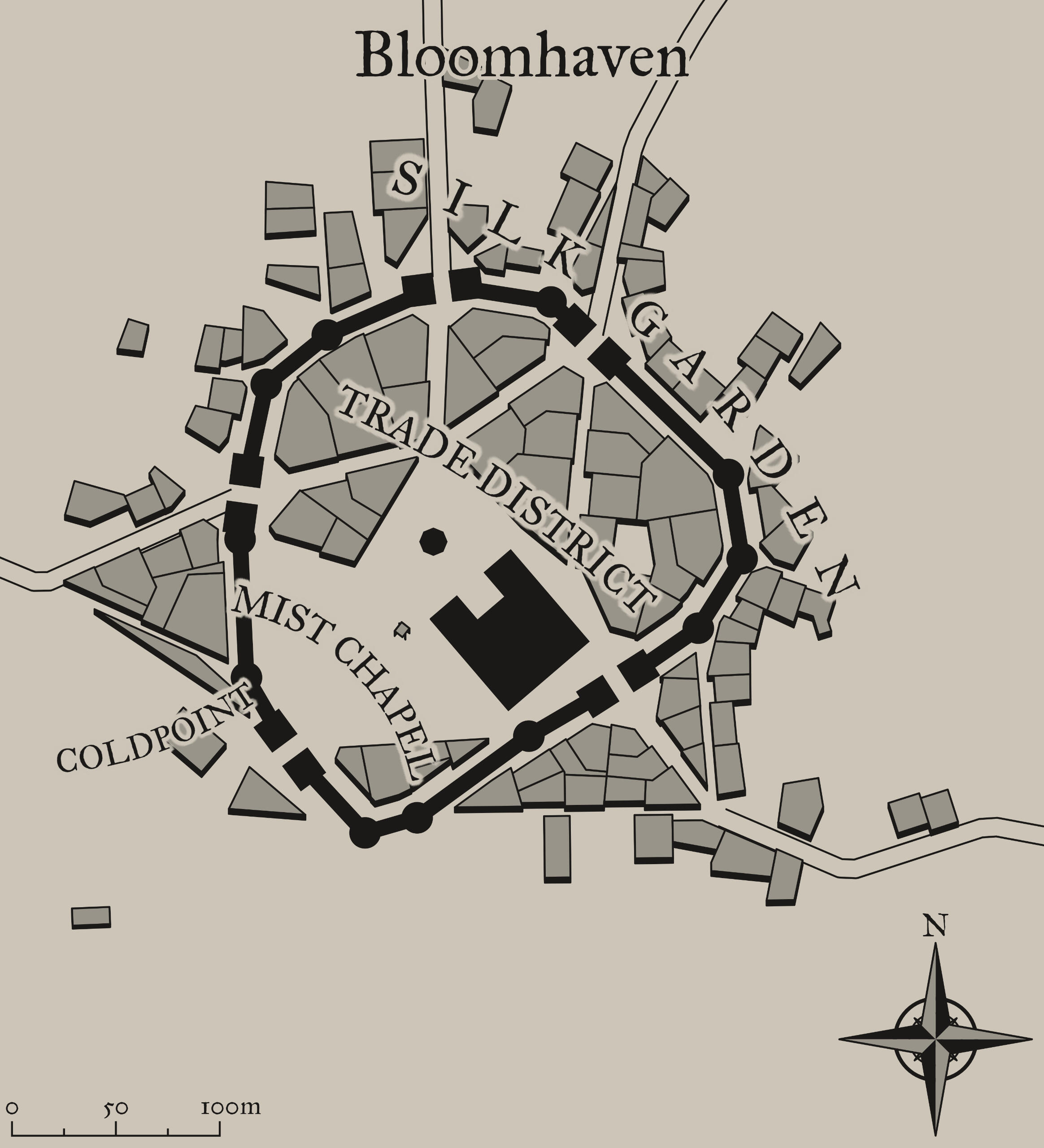
Bloomhaven is a very small town, no more than 300 in its midst. However, it's a rich combination of cultures that forms a very unique but tight-knit community. Originally a human settlement in the wood elf country, many travelers have came through, shared their cultures, and some settled down to join. You can find anyone from humans, elves, orcs, dragonkin, tiefling, aarakocra...the list seems endless sometimes.
Barland
(Central Coastal Findeste)

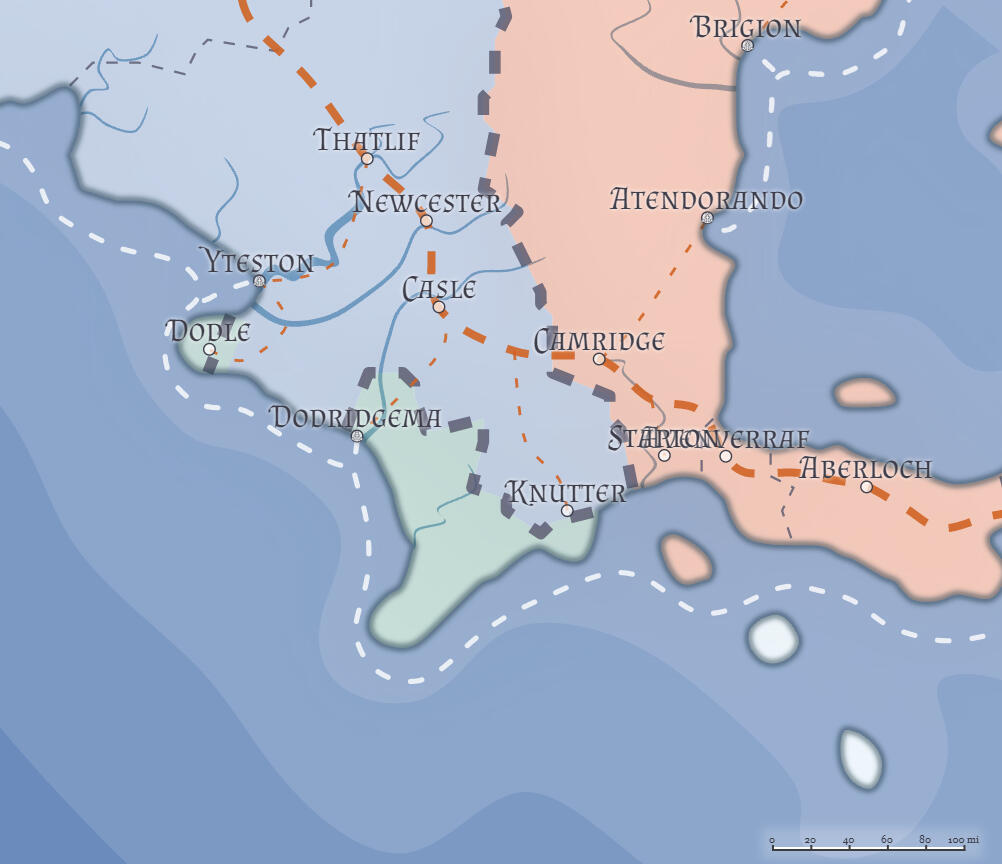
Barland is one of the three countries that make up Coastal Findeste, being the center country in between the northern Walden and southern Tasinland. You'll see it as all the green land mass on these maps, whereas the reddish is the Empire and the purple is Tasinland. Like most of the Coastal Findeste area, the population is mostly human with a good sea elf population towards the coast itself, along with all ambi variants and such. Barland is technically divided into two sections, while it's a technicality at best. There's the mainland and two small colonies on the southernmost ends of Tasinland, hence the two pictures shown.
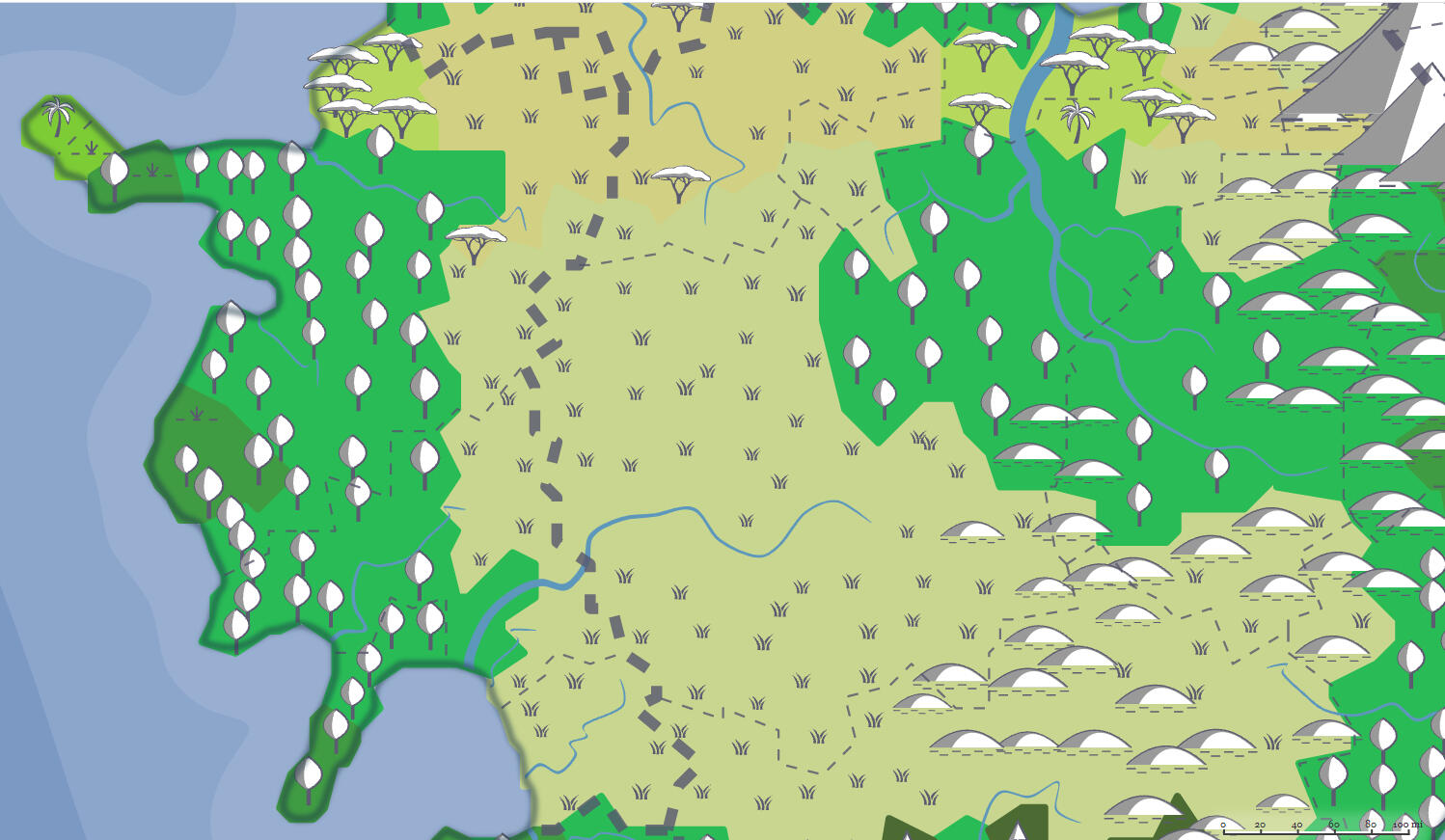

Barland has one main environment: Temperate Deciduous Forest. The large green section that takes up most of the country is all forest. Going up most of the Barland/Empire border in that cream-colored section is Grassland, with a Savannah at the Tri-Country Border and Tropical Seasonal Forest in that yellowing area by the city of Borougbury. The darker green portions are Temporate Rainforest, and that dark yellow area by the city of Blechethe is Tropical Rainforest. Going down by the colonies at the far south, the dark green is Wetlands while the brownish-red is Tundra, and any white is just pure glacier or ice. As far as elevation goes, the majority of the country is sub-100 feet above sea level, maxing out around 400 feet by the Barland/Empire border.


Barland's society and government is fairly simple, being lightly based on ancient Celtic societies from Iron Age Europe. It's a monarchy where the aristocracy gains power based on the land they own, and those in power sign an unwritten and binding contract to help provide for those below them that live on their land. Those county rulers will establish their own laws based on a general law established by the king's appointed governors. Unlike most monarchies though, this is a very cooperative system: the county lords provide safety and security for their peoples, and the peoples provide their labor and loyalty to keep the system in working order. There's rarely any corruption when it comes to Barland's society and governing system.As far as social status is concerned, after the king, county rulers, and general aristocracy, the hierarchy falls to powerful Barland warriors, then druids, then your specialized workers in terms of trade, farming, all the way down to your poverty-stricken. It's a simple pyramid, where the higher up you are, the more respect and influence you have around you.To start off our list of areas is Warravia County, the main county where the capitol city of Helford is located. From there, the king of Barland rules, King Sifton Sinclair of Barland. He also owns the Pensia Territory, the area of pure rainforest just northwest of Blechethe, as it's an important historical area to the sea elf and human alliance. The next county to the south is Mitham Shire, ruled by the king's brother Duke Reginald Sinclair of Mitham. Both of the counties just south of there, Darboham County on the west and Sifon County on the east are ruled over by the king's sisters, Duchess Regina Sinclair of Darboham and Duchess Artriam Sinclair of Sifon respectively. The whole family is half-sea elf and known for their skill at keepings peace and encouraging cooperation between human and sea elf alike, and they're very well-liked for their grounded stance on working on the country's improvement and numerous public relationships campaigns.As we leave the mainland, you may notice the greenish parts there at the southern end of Tasinland. Those, being Dodle County and Qualand Colony respectfully, are actually parts of Barland. They're run by an appointed Count Prolthiac Torqin of Colonial Barland, a white dragonborn whose clan has long been allied with the Sinclair's sea-elf parentage throughout history, and most of the triton population lives there in those colonies along with clans of white and silver dragonborn who can stand those harsh, cold temperatures. Those areas are part of Barland's history, so back when borders were being drawn after the Final Gambit, Tasinland agreed to have those areas remain in Barland's ownership. Dodle County specifically is relatively secular in its inhabitants, and the Count focuses more of their attention on Qualand County, leading to unsavory rumors regarding the types of people that have since moved there and what practices go on.
Going even more specific, the buttons below will take you to maps and details of certain cities of any interest within the given country.
Dodle
(Town of the Dracolich)
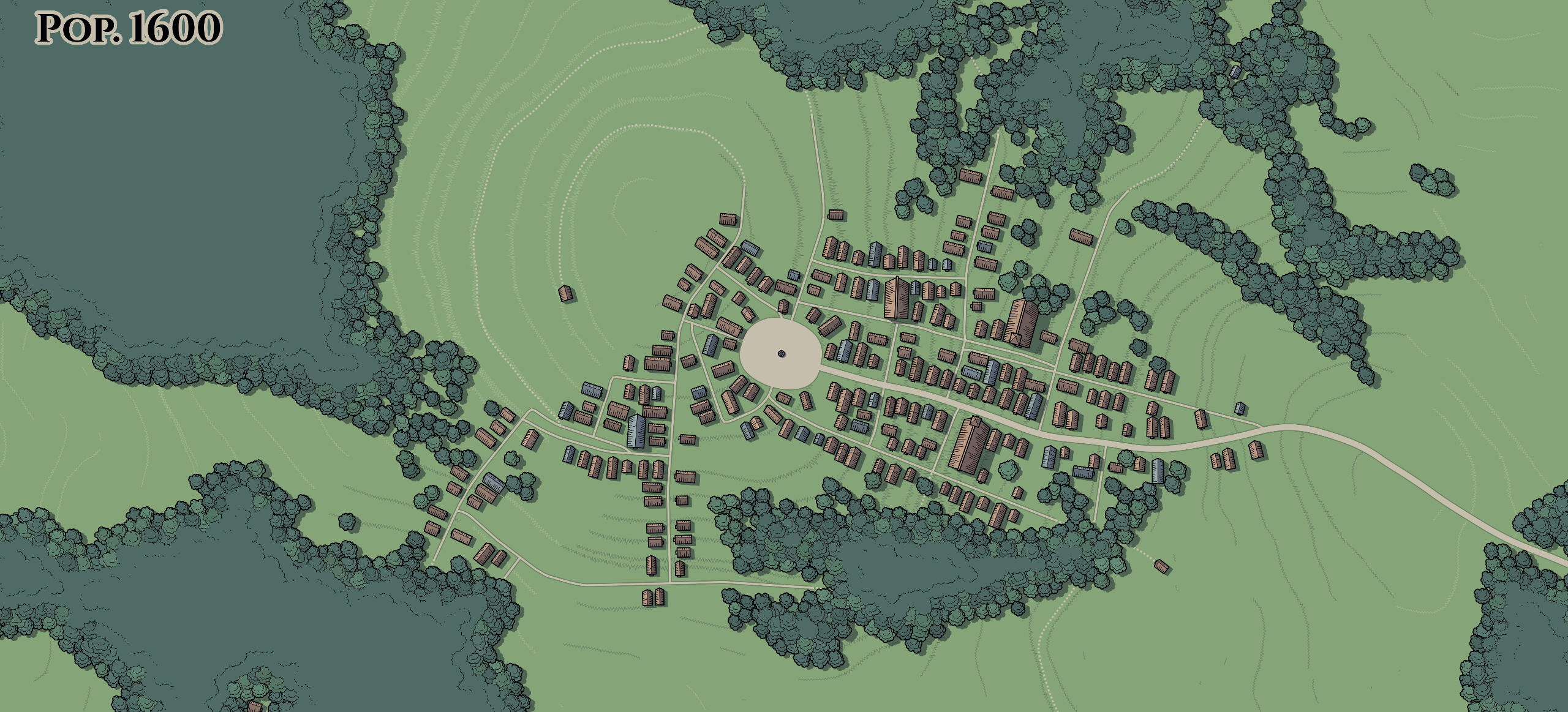
Dodle County is a tiny section of Colonial Barland, small territories on the southern-most parts of Tasinland's border with the ocean. Dodle is a small town that mostly keeps to themselves, hosting some form of dark secret. Many in this town are thought to be necromancers, though they're quick to hide all trace of the idea should some foreigner be sticking their nose into places it doesn't belong. Most west of the town is a large castle, decrepit yet standing amidst the volatile weather, and current reports claim that a former Barland soldier has since become a warlock of a powerful dracolich, holed up there as her home and living the traditional "vampire" lifestyle.
Dodridgema
(Colonial Barland)
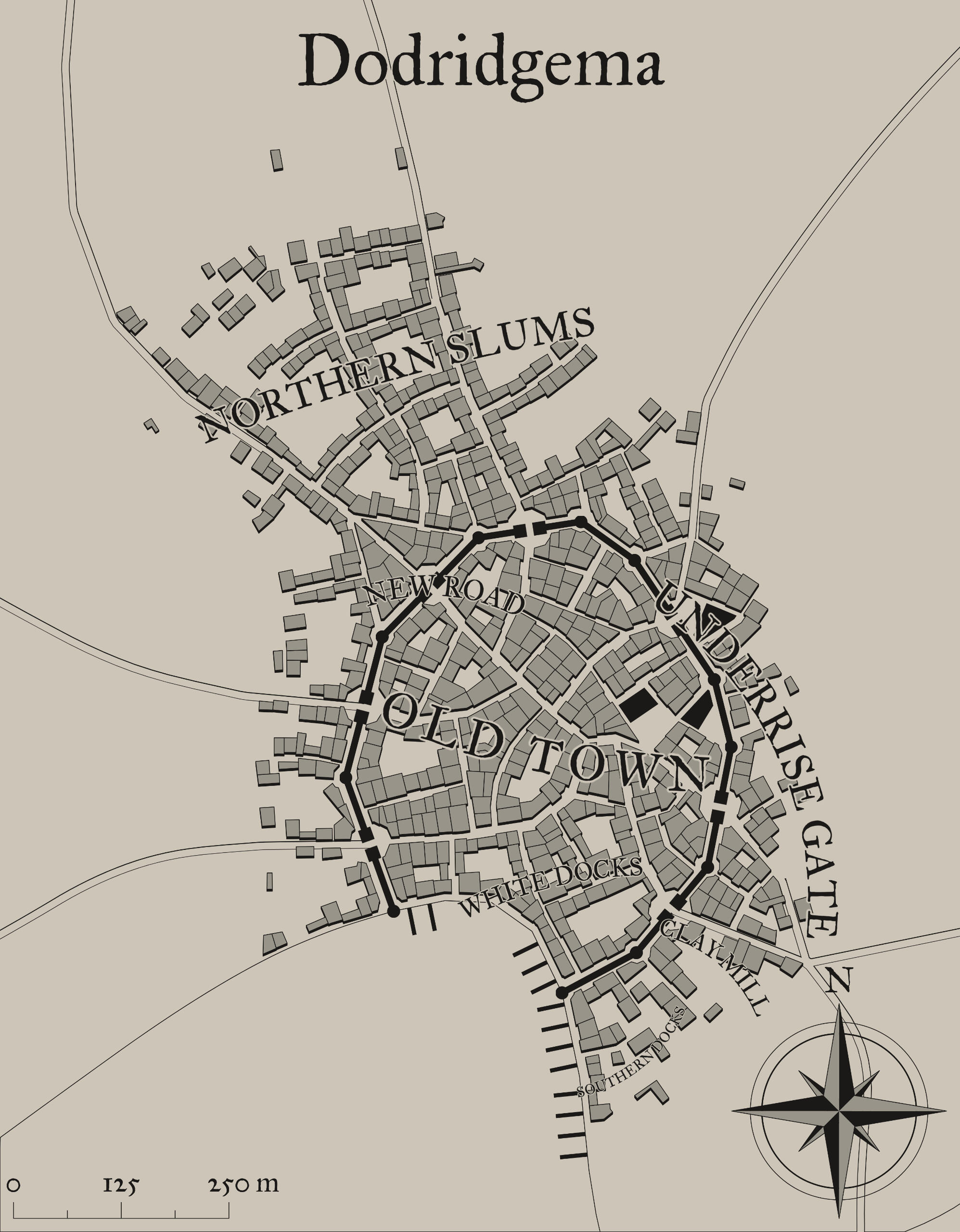
Dodridgema is the main "hub" of Colonial Barland, which is to say its the only city in the Qualand County of Barland. It's a very old-styled city, aged from the early days of Ambies and keeping many of those traditional values. Most of the population is white and silver dragonborn with the usual amount of sea elves you'd expect from Coastal Barland, and throughout the whole county, you may vine the tiniest of villages that barely make 100 people in population.
Helford
(Capitol of Barland)
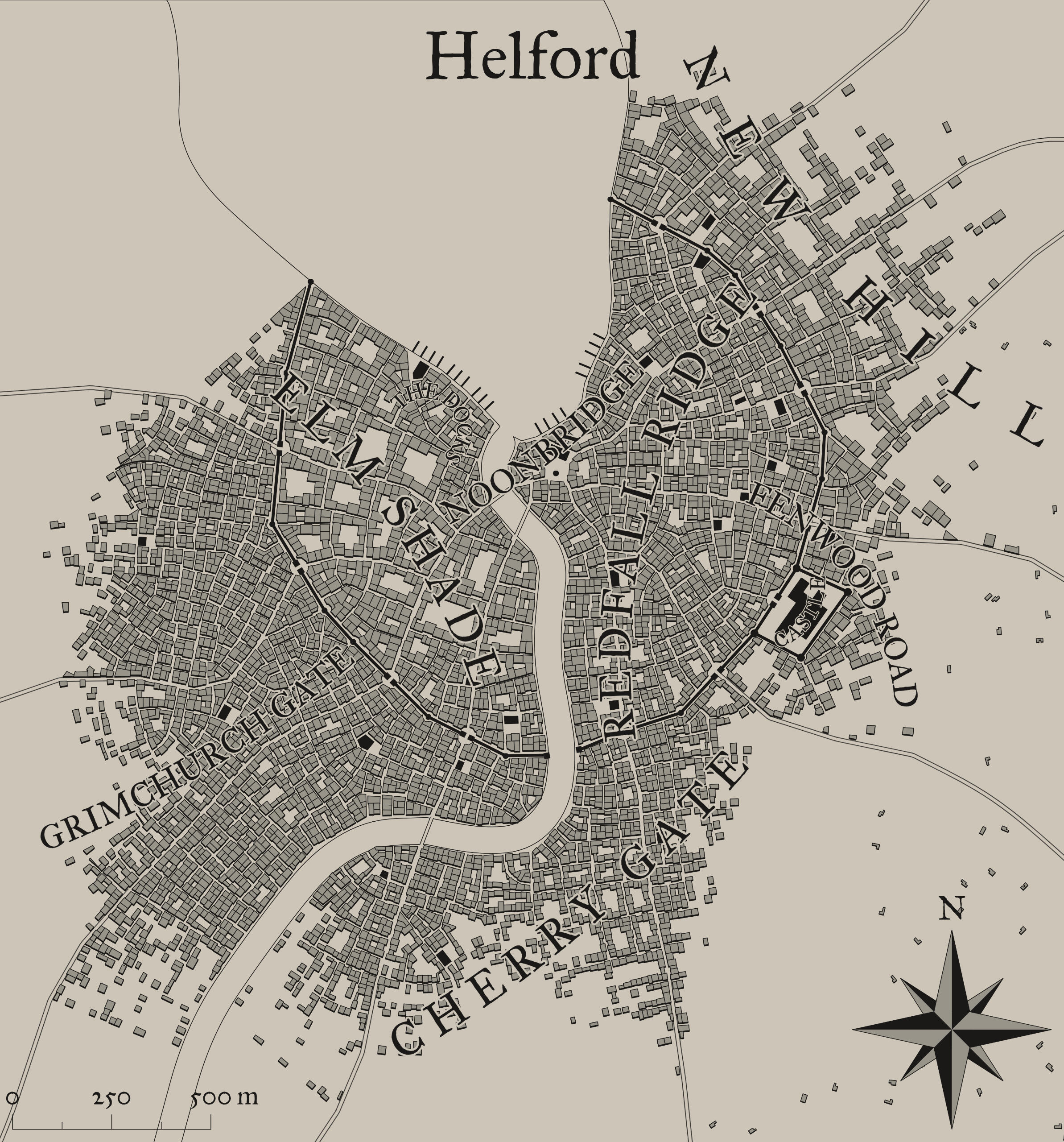
Helford is our captial city of Barland, boasting an almost 50 thousand souls in its limits as a large hub city and center for trade with being a port town as well. It houses the King Sifton Sinclair in the castle at the northeast corner of the city. Most of the population is sea elf, triton, and humans, and the large river entering into the Helford Bay makes it a very booming business town for all sorts of seafaring jobs from fishing, travel, trade, everything under the sea. There's even a ferry service between Helford and Cleolesdon, the smaller city just north of it, where most of the non-natives settle and travel for work. It's the epitome of a booming business town and serves as a respectable hub and capitol for Barland.
Tasinland
(Southern Coastal Findeste)

Tasinland is one of the 3 countries that make up what's colloquially known as "Coastal Findeste". The area's culture is loosely based a mix of the indigenous peoples of North America, their cultures being based around the same tribes that lived in the respective biomes of the areas. The population is mostly human, with few Genasi and Animal Ambi inheritors that lead into this. While it's still a modernized version of a fantasy society like Walden and the Empire having your "generic" fantasy cities, there are still many remnants of the traditional culture that Tasinland was prior to the Final Gambit.

That big blotch of dark green that covers most of Tasinland is pure Taiga. It's a very cold region for sure. What isn't taiga is usually Wetlands, which is the next shade up. Those two biomes make up the majority of Tasinland. There's some Tundra at the southernmost points of the country by glaciers and all, and at the north towards the Barland borders are few bits of Temperate Rainforest and Temperate Deciduous Forest.

The altitude is mostly low, around 100 feet above sea level or less. It only gets into the higher numbers towards the north-eastern borders of the country. Otherwise, it's mostly just conifer trees, grass, swamps, and snow.

Tasinland runs as a standard monarchy, the three counties being run by the current monarch, the spouse of the monarch, and the firstborn child (or next sibling of the current monarch if no heir is apparent). The center county is the Stania Barony, called a Barony due to the old capitol not being here previously. Now, the capitol is Walbor, ruled by King Armando Girtablulu of Tasinland, an Aarakocra man. His wife, a human woman named Queen Cybil Girtablulu, rules over the county just north, Loutwark County. This is meant to symbolize how in Tasin culture, every man should hold the women in his life held high above their heads for guidance through life. His firstborn daughter, another Aarakocra by the name of Princess Isis Girtablulu is is the Duchess of Bolces County, the county south of the capitol. This represents how every man should keep his fruits beneath him so that all the wisdom he collects in life will spill out of the cup of knowledge he holds and onto his children.
Going even more specific, the buttons below will take you to maps and details of certain cities of any interest within the given country.
Walden
(Northern Coastal Findeste)

Walden is one of the 3 countries that make up what's colloquially known as "Coastal Findeste". It takes the north-western corner of Findeste, and you can see them as a parallel to a Viking state, full of Norse themes among the humans, sea elves, and tritons that tend to make up the country. It's not quite as organized and structured as a more modern empire like, well, the Empire, and nor is it some mystical or even futuristic utopia like Caltaurum, but the humans of Coastal Findeste tend to be very modest and traditional with their standard of living, and the case is true here in Walden.
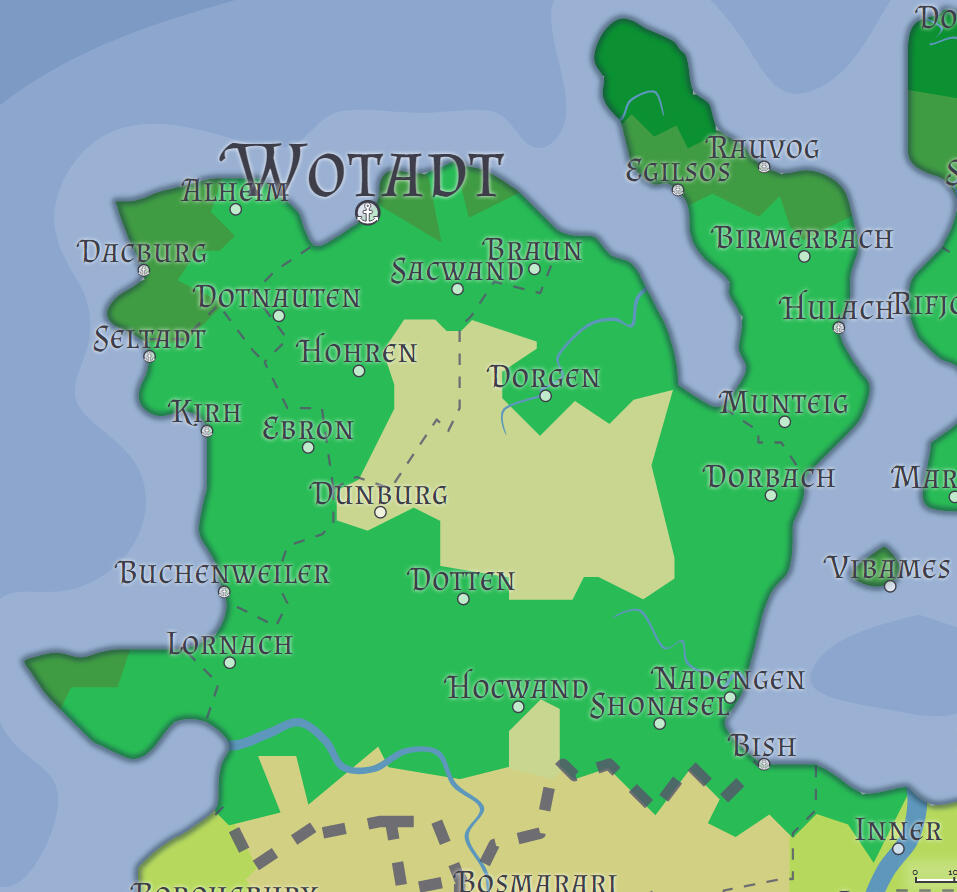
Walden isn't exactly a country with what one would call a "diverse ecosystem". Due to woodwork being a very integral part of Walden society, almost all the cities in the country tend to be in the temperate deciduous forests that make up most of the outer edges of the country. The center of Walden is simple grassland, but it used to be a lush forest ages ago until people stopped replanting trees in that area. The westernmost and northernmost tips of the country have some temperate rainforests and even a bit of wetlands north of Egilsos and Rauvog. The southern edge of the country towards the borders to the Empire and Barland are savannahs that are largely uninhabited by citizens of Walden.

Aside from a few, small, rolling hills and such (indicated by the green-yellow discolorations), the majority of Walden is less than 100 feet above sea-level, the average being about 40. Deciduous trees spread across the entire place aside from the grasslands in the center and savannah to the south.

Starting from Wotadt, the capitol city of Walden, we have the Oberbach Barony, which is ruled over by a human named Baron Ostenhaff Vridek. Vridek was sean as a king and gentle man who ruled over this county. In Walden, the traditional titles of King, Count, and all the others have no place in their land. The Baron is the high title, and the Barons of each province all rule their areas independently and convene regularly to discuss issues and potential improvements. They are known as the Coalition of Walden, and they're a fairly respected oligarchy among the other nations. This ties back to the idea that Walden does things in a very traditional sense; in this case, letting the people govern themselves and live happy lives while supporting each other. It's not exactly a perfect hierarchy in some instances, but it makes Walden a very nice place to live.The very northwestern tip of the country, just to the west of Wotadt is the Renhingen Barony, ruled out of Dacburg by a triton woman named Baroness Vensa Eroe. She was a bit of a hard-ass as times, and while her county was certainly more structured than the others, people still enjoyed the life they had there.Just to the south of there is the Otenheimia Shire, ruled by a sea elf named Baron Bahrastos Elaruz, also known as Bahrastos the Fathomer. He rules from Seltadt, and he and the tritons from the north all battled valiantly against the raging sea creatures and demons that would attack the northern coasts. He's defeated a kraken with just his own personal ship and crew, so the source of his power and the reason people are devoted to him is pure respect.The largest county, which takes up the majority of the country as a whole, is the Shildenia Barony, ruled over by two people: a human by the name of Baron Edward Edelburn and a half-sea elf named Baroness Evie DiMarcus. Edelburn rules over the western side, and is the sole owner of the Thethamia Territory, the peninsula just to the west with no cities in it. The eastern side is ruled by DiMarcus, and she also owns Vibames Island, the small island in that body of water between Walden, the Empire, and Caltaurum known as The Siren's Noose. They're known for being very amicable people, with their citizens and with each other, so handling such a large area together isn't much of a hassle for them. They rule out of Dotten and Dorgen respectively.The last county is that north-eastern peninsula, the Birmerbach Earldom, which is run by a human water genasi named Earl Kratos Erebus. He acts as the diplomatic emissary for relations between the Empire and Caltaurum, hence why his title is "Earl" as opposed to Baron. This role is not one that is taken lightly, but it is also highly revered. While the name bears extra responsibility, it does not make him any more superior of a leader to the others in the oligarchy.
Going even more specific, the buttons below will take you to maps and details of certain cities of any interest within the given country.
Egilsos
(Rauvog 2.0)

Egilsos was established a couple years after Rauvog was, as a means to have some sort of land route and port on the opposite side of the peninsula. It isn't too significant of a port city; it isn't too much hassle to spend a bit of extra time to sail from the west coast to Nauvog, but if the weather is particularly bad, sailing to Egilsos and then making a land trip to Nauvog is not a bad option to avoid treacherous seas. Other than that, anything you could find at Nauvog, you can find at Egilsos.
Kirh
(Small-Town Port Town)

Kirh is a smaller port compared to its big brother of Seltadt, but it's also a part of the naval effort as well. Boasting a proud military district, it serves as mostly a secondary set of ports for Seltadt efforts. The rest of the town is just smaller and older, a remnant of older Walden, but it's still a fairly lively place that's on the path to other places.
Dacburg
(The Northwest Corner of the World)
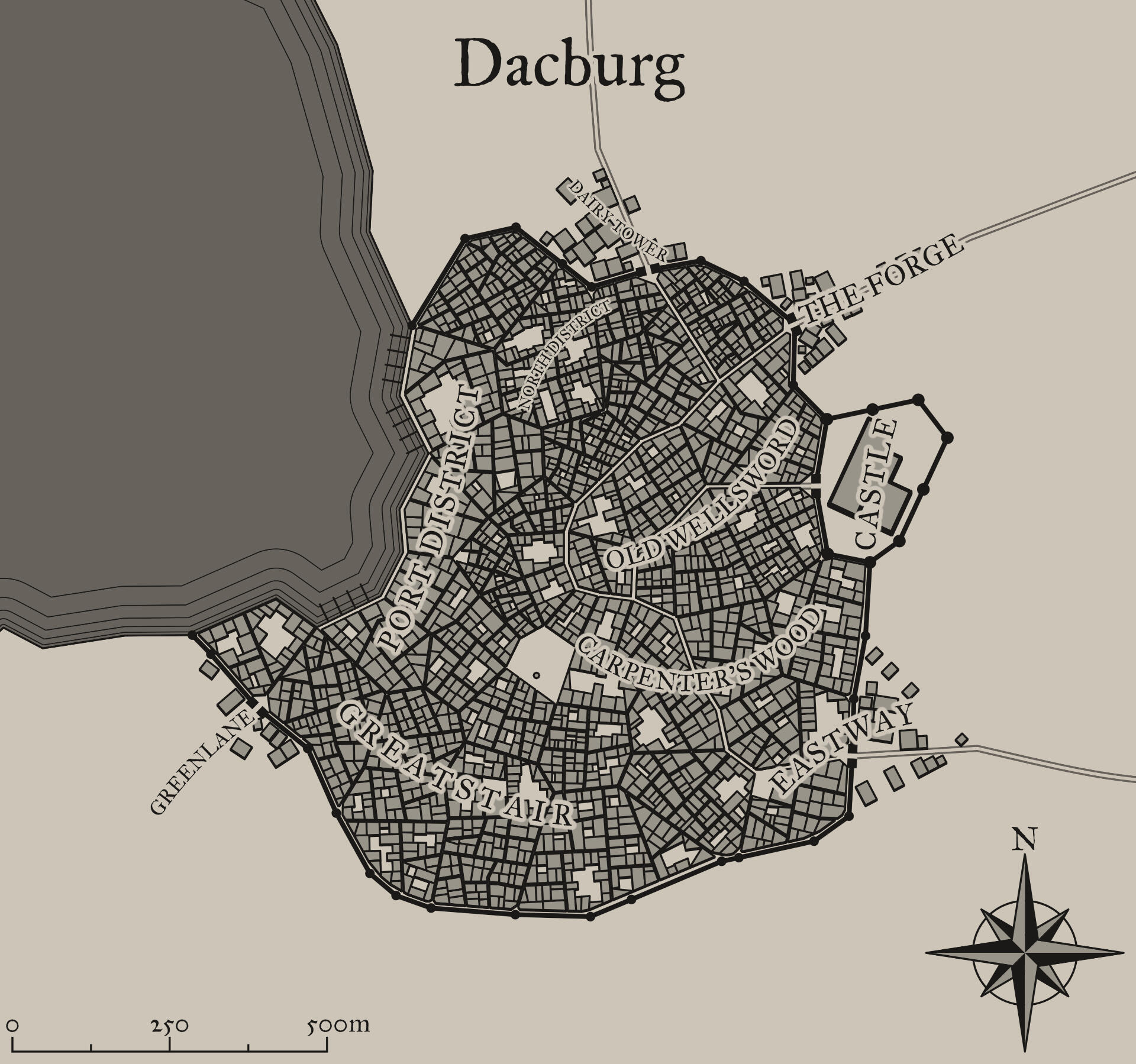
Dacburg is the flagship city of the Renhingen Barony, and as such, Baroness Vensa Eroe rules from there. Dacburg is a mostly sea elf and triton city, where triton and sea elf customs can be studied and respected by the many humans of Walden. It's a cultural icon of a city, and it's a very important place to visit when wanting to study up on human/sea-elf/triton relations and customs of our aquatic brethren.
Hulach
(Gateway to Bish)

Seeing as how Bish, an Empire border city has no direct land route into Walden, alternate methods had to be made. The Empire as a whole has only two ways to get to Walden: either traveling southwest to Barland and then north to get to Lornach and Buchenweiler, or sailing north from Bish and into Hulach. Hulach is often seen as the quicker option, and as such, Hulach is another one of those "immigration cities" that are popularized in the Empire, but with a Walden-spin on it. However, the most usefulness that Hulach has is serving as the closest city to the Empire to reach Birmerbach for diplomatic affairs with the Earl. Still, a lot of immigrants from the Empire travel to Hulach and then spread from there, mostly humans and sea elves with familial ties to Walden.
Rauvog
(To the Northern Coast)

Rauvog is one of those necessary port stops for any sort of long travelling. Whether you're going north out of the Vibames Sea, headed due east towards Caltaurum and further on, or headed west to head down Coastal Findeste, Rauvog is always a necessary pit-stop along the way. It's an older town, the fortress being old but still useful for the harbormaster who runs things out of this town. A lot of business here supports the port, which has arguably some of the best port authority in all of Walden due to its positioning. Typically if you see a ship passing Nauvog rather than docking there for a night, they're either in a big hurry or carrying something they wouldn't want port authority to get their eyes and hands on.
Wotadt
(Capitol of Walden)

Wotadt of one of the largest Walden cities, and its positioning is advantageous for most sea missions. Due to this all, it was chosen to be the capitol of Walden, the main city for the Oberbach Barony, and the home to Baron Ostenhaff Vridek. He is a hefty human man, bearing a strong resemblance to the "viking" stereotype, and he very much puts his people's needs at the forefront of society. He works hard to make sure his people get what they need, as soon as possible when they need it, and in good quality. While large quantities of resources for stores and such are distributed on a "by need" basis, fraud is a heavily punishable crime in most of Walden, so the idea of trying to lie and get more than they need is rarely thought of. Overpopulation isn't an issue either due to a generally lower life expectancy due to the sea creature attacks and young men and women often being drafted into the military if they aren't going to higher education for other jobs.
Seltadt
(Home of the Fathomer)

Seltadt is the main city of the Otenheimia Shire, and as such, Baron Bahrastos Elaruz lives and rules from here. A powerful sea elf has amassed a loyal following and created a very strong naval force specifically for destroying outsider threats. While very unlikely that other parts of Walden or even other continents would attack, the main defense is from sea creatures. Some nasty creatures out there that the deep-sea tritons cannot handle alone occasionally find their way to the surface and make for land, so it is up to these western port cities to defend Coastal Findeste from them. Bahrastos is known for leading a single ship to fight an armada of sea harpies with just his crew and his magic while emerging victorious and not losing a single crew member. All across Coastal Findeste, the story of Bahrastos the Fathomer is known, which makes Seltadt a very popular place. It's a hero's hometown.
Buchenweiler
(Two Ways to Barland)

Buchenweiler is the southernmost port city on Walden's west coast, and it is fairly close to the border to Barland just to the south. As such, there are two ways to get to Barland from here. The first is the obvious, chartering a boat and sailing along the coast to reach Helford. Alternatively, you can travel by land south from Buchenweiler to cross the Walden-Barland border and eventually reach Borougbury. One important detail to note is that while the oligarchy members do not live in certain towns, most have castles. These used to be for previous oligarchy leaders, and for most towns, they're reserved for the harbormaster or local governor as they essentially run the town in the stead of one of the Barons.
Caltaurum
(Citadel of the High Elves)
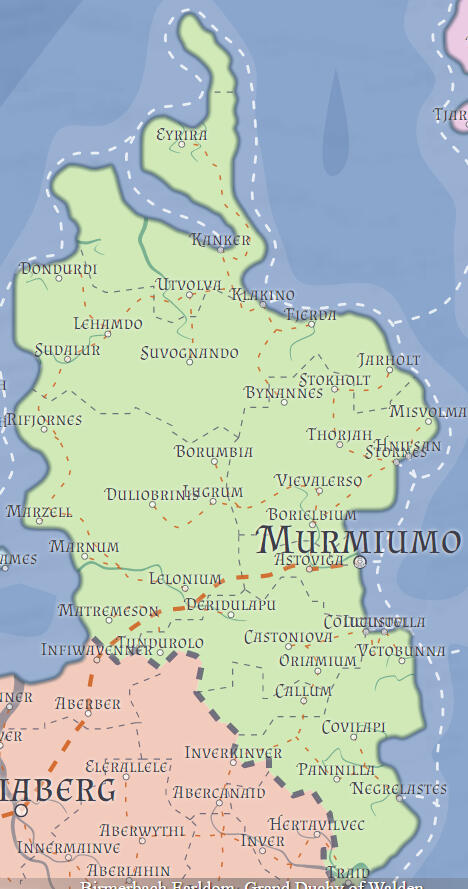
Caltaurum is known as the "high elf purist" nation, over 90 percent of the population being pure-blooded high elves and high-elf-based genasi. The rest is usually filled with humans, half-elves, and a few sea elves for trade purposes. Due to the restrictive nature of the continent's border with the Inernantian Empire and other continents you have to access via sea, Caltaurum is very reserved and advanced within their own rights. For an easy comparison, think of it like the Wakanda of this world, if you know your Marvel Cinematic Universe well. Caltaurum keeps to itself as much as it can, and its people live in relative utopia due to the high elf's natural inclination for powerful Ambies and a high intellect to study potent magic. They can sometimes be seen as too reliant on their natural abilities and aptitude, but when not much can really combat them, they hold themselves to a much higher standard than most of the other races and countries.

The center area of the continent around Duliobrinis and Lugrum is simple grassland, and as you head outwards, you grow into more and more forest areas. The capital of Murmiumo is in a temperate rainforest area, with wetlands continuing south along the coast with a tropical rainforest and tropical seasonal forest around Covilapi. The temperate rainforests and wetlands continue northwards as well, even a few taiga biomes appearing in the darker areas on the northern tips of Caltaurum.

The southern end of Caltaurum, the mountain area that spreads past the border to the Inernantian Empire, is known as The Fingers of Terros, a vast mountain range with very steep mountains that almost resemble an army of hands reaching out from under the surface. Otherwise, most of the rest of the continent is fairly consistent with types of plant life - grasslands, marshes, and mostly deciduous trees aside from the warmer climates that produce rainforest environments. Aside from the mountains and surrounding hills, most of Caltaurum is just shy of 1000 feet above sea level, spreading thin as you get to the marshlands and coastlines.
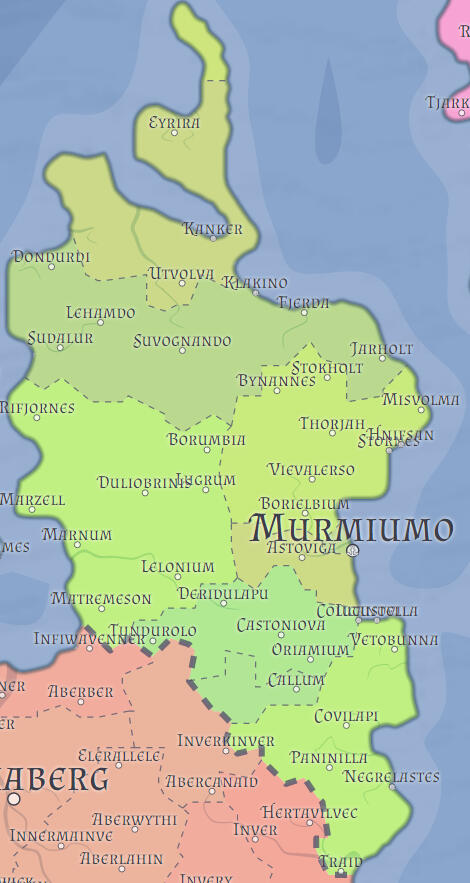
Caltaurum is divided up into 8 counties, but while it's much smaller than the Empire, it's still densely populated and requires its own monarchy and ranking system similar to the Empire's.King Sordukar Khramous, a powerful high elf sorcerer rules out of the capitol city, Murmiumo, in the Astoviga Country, which is ruled over directly by him and his wife, Queen Tuiorne Khramous of Astoviga. It's often referred to simply as King's County by other Caltaurum natives.Going south from there leads you to Vintolinia County, the Lutesiumia Territory, and Negrelastes County. Vintolinia is ruled by the King's firstborn son, an air genasi named Prince Eldadael Khramous of Astoviga, while he also has the title of Duke of Vintolinia. Prince Eldadael's two children rule over Lutesiumia and Negrelastes, their names being Countess Neria Khramous and Countess Tenel Khramous, respectively.To the west is Duliobrinis County, ruled by the second son to the King, Prince Erranaro Khramous of Astoviga, also known as the Duke of Diliobrinis. The north of the capitol is Vievalerso County, ruled by the King's thirdborn son, Prince Ilmidur Khramous of Astoviga, a.k.a. the Duke of Vievalerso. Prince Erranaro is an Air Genasi while Prince Ilmidur is a pure high-elf, who takes his pure lineage very seriously.Proceeding futher north is Suvognando County and Kanker County, which are ruled by his fourthborn son and only daughter respectively. Prince Moralin Khramous of Astoviga, a.k.a. Duke of Suvognando. His daughter, Princess Arquia Khramous-Chaeiuth of Astoviga, is a half-elf born to him by a previous human-based Water Genasi consort from the Empire. To maintain appearances, she is only a Countess of Kanker, but she embraces both of her family's lineages. She was also given Kanker county due to its remote location, despite Kanker being a dense city. She also owns the Rogdageria Province at the very northern tip of Caltaurum, a thought to be uninhabitable area.
Going even more specific, the buttons below will take you to maps and details of certain cities of any interest within the given country.
Hnifsan
(Sister to Stornes)

Not much can really be said about Hnifsan. It's another port city in Caltaurum, part of the same area as her sister city, Stornes. Whever one city doesn't have, the other one typically does, so they're two parts of the same place: a northern Caltaurum port where Northern Netrodino ships dock at.
Stornes
(Sister to Hnifsan)

Not much can really be said about Stornes. It's another port city in Caltaurum, part of the same area as her sister city, Hnifsan. Whever one city doesn't have, the other one typically does, so they're two parts of the same place: a northern Caltaurum port where Northern Netrodino ships dock at.
Vievalerso
(Living it Big)

Vievalerso is the epitome of "high elf narcissism". Homes made from exotic woods with plants that cost more than a month's salary, food covered in gold shavings for "added flavor", and the most blatant segregation of pure high elves and any other race out there. Even half-elves with high elf parents or half elf genasi are openly discriminated against, and no one says does anything about it because that's just the type of people that high elves can be, especially Prince Ilmidur Khramous, the Duke of the county.
Duliobrinis
(Sorcerer's Peak)
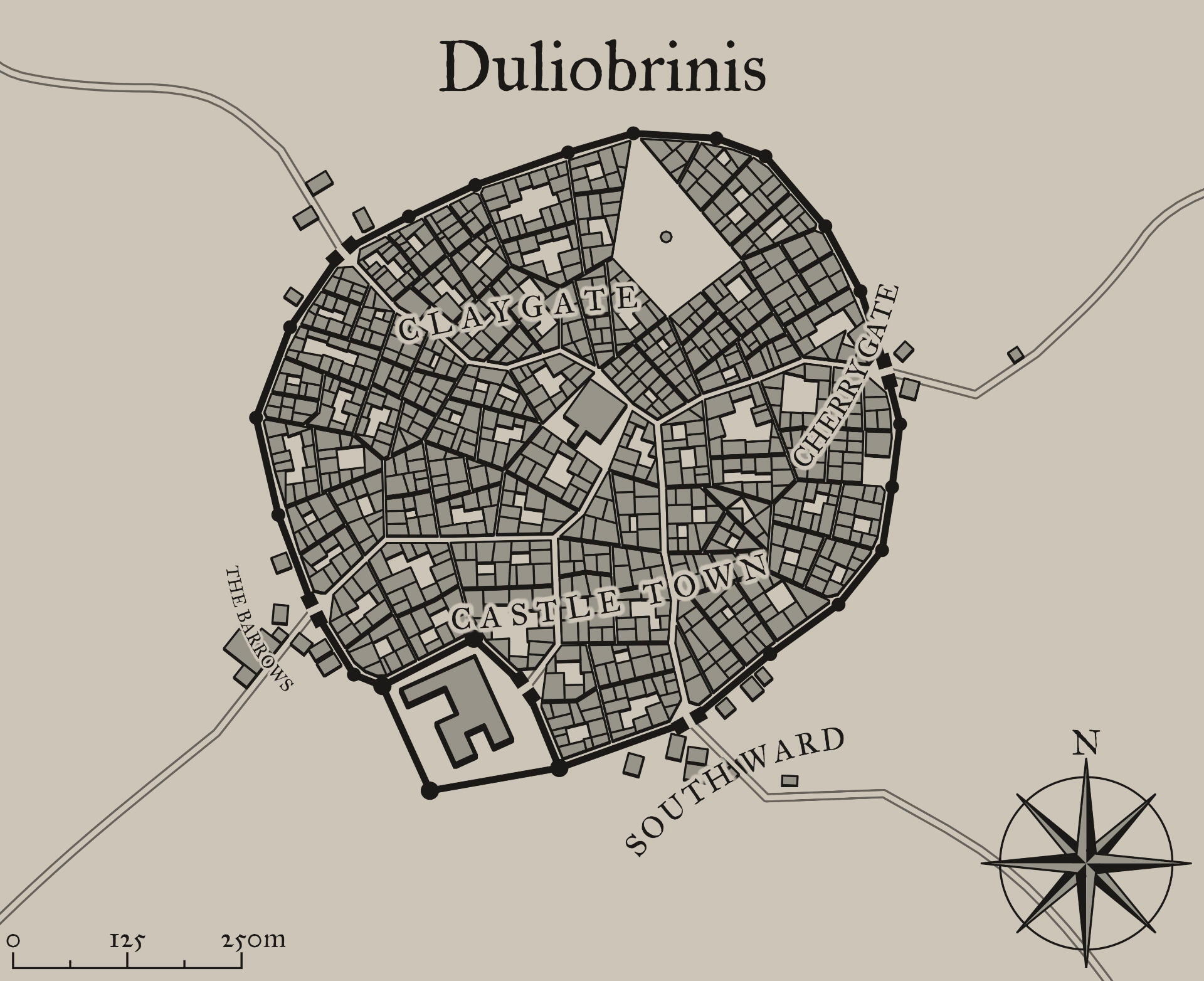
Duliobrinis is already an important city. County capitol, dense population, busy place. It's also home to the Sorcerer's Museum, an in-depth guide to anything and everything related to Sorcerer's Ambies, the most powerful Ambies in all of history. You can learn about powerful past sorcerer's that tried to cause imbalance in the world, see scrolls that have ancient inscriptions of sorcerer spells, and even some artifacts of long-gone sorcerer's of history.
Lugrum
(The Stopover City)

Lugrum is a small town. A reeeeeeeally small town. Still, it's very much an important place due to location. It's right in between Duliobrinis and Viaevalerso, and the trek between those two county capitols can be quite taxing at times. So, Lugrum makes for a healthy stopover point for people to rest their bodies and minds, and it's taken the whole "relaxation" theme to the next level. There's a very popular hot spring and spa in the small town that's very reputable, and Lugrum has developed quite a tourism attraction despite being a small and mostly rustic town.
Kanker
(The Tip of Caltaurum)

Kanker is a very dense and thriving county capitol, and it's also the stop you make before you try going to the Rogdageria Province, just north of Kanker County. Legend has it that an old entrance to the Underdark was there, along with a proper surface down for drow before high elves destroyed it with powerful Ambies and magic during the elf wars. Some people think the land is inhospitable, and unless you have proper permission from Princess Arquia Khramous-Chaeiuth, the current ruler of Kanker. She owns that land and keeps it as a sacred ground, and she is one of the only open and prominent drow sympathizers in all of Caltaurum, mostly due to not being a full high elf genasi but being a half-elf genasi. She doesn't harbor that unnatural hatred for drow that most pure high elves do.
Klakino
(Sea Elf Communications)
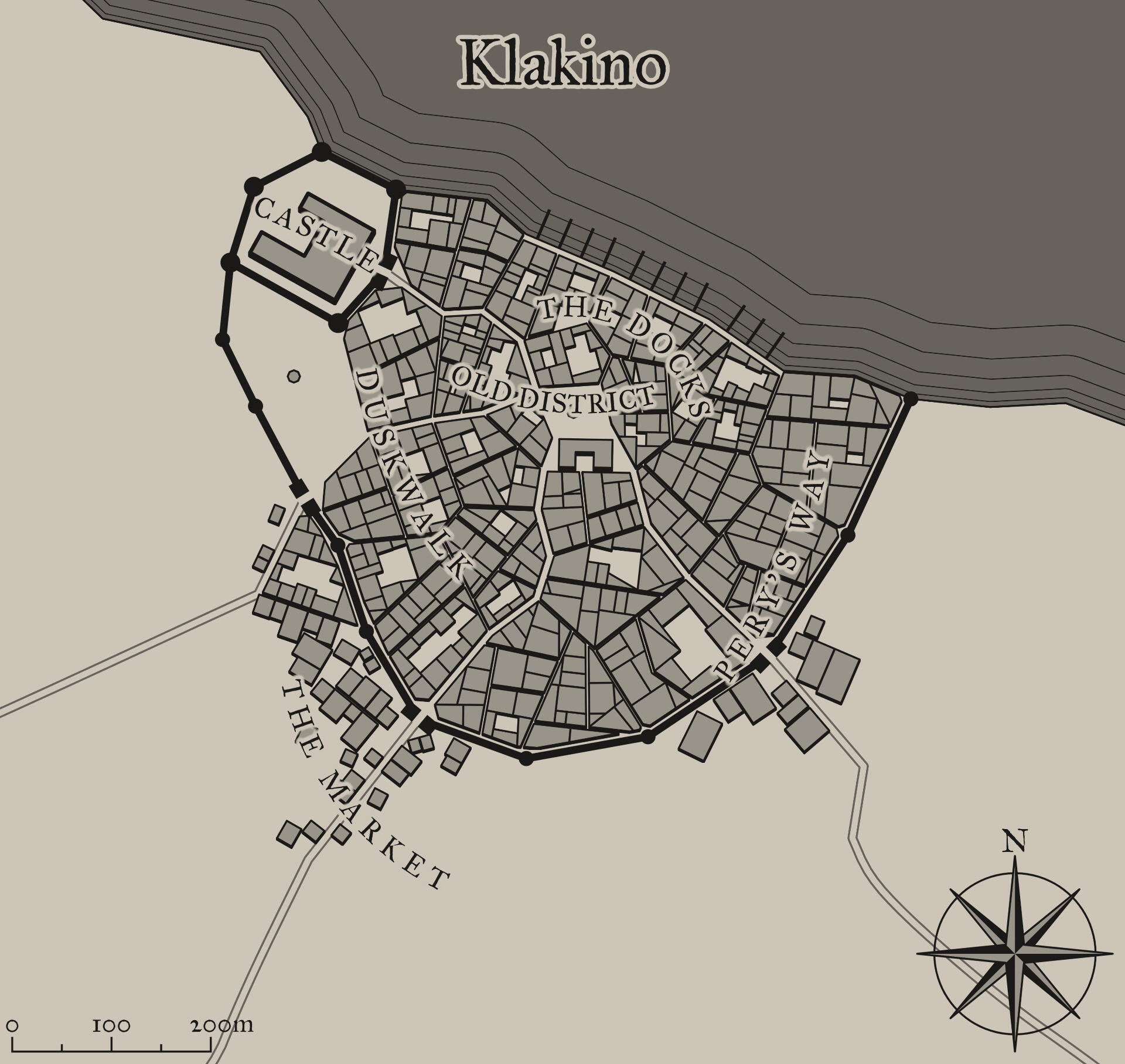
Kanker, at first glance, just looks like a standard, smallish port town in Caltaurum. However, this city has a fair amount of sea elf population too. While the high elves are always incredibly pretentious, their relationship with the sea elves isn't bad. They coexist and do business, which is what happens a lot here. Many sea elves offer chartering services for ships and whatnot, along with being the go-to stop from Melia and other sea-elf-centric ports across Findeste.
Iucustella
(An Extension on Murmiumo)

Murmiumo is a large city. A laaaaaarge city. With a thriving and growing population. Naturally, the easiest thing to do would be to make more buildings, but with the limited space around, they opted to make a second city just down the coast from them. IN fact, they made two of them! Iucustella was the first and larger, holding about a 4th of the population that currently lives in Murmiumo. The second is Colicanovi, a much smaller city just west of Iucustella that took the run-off from it. These 3 cities form the area known as Capitol Heights in Caltaurum, and it's where the richest and most powerful members of Caltaurum and high-elf society live and do business.
Negrelastes
(The Great Bazaar)

Another dense and popular Caltaurum city, Negrelastes is a thriving port town who focuses almost entirely on the trade business. While Murmiumo is a somewhat busy port city as well, Negrelastes is often called the Great Bazaar of Findeste due to its ease of access from all directions of water routes. Empire, Caltaurum, and the Netrodino/Melia area, you can find a multitude of items from a multitude of cultures, races, and histories. Of course, Countess Tenel Khramous lives and rules here as well, and she is often revered as a "patron saint of trade wind". She's an air genasi, like her father and sister, and her general publicity and willingness to walk amongst the people and solve problems head-on lead people to treat her like a Princess Diana of sorts. People say she uses her Wind Ambi to make the winds of the world blow everyone to Negrelastes for a warm and inviting melting pot of a port town. Most of the 10% population of non-high-elves lives here in Negrelastes.
Borielbium
(On the Road to the North)

If you aren't going east from Astovigo, then you're heading north to Borielbium. The main road from here is what leads to the northern, less populated areas of Caltaurum. The Flalastames River flows through it, and it's noticably teem with migratory fish during the winter and summer seasons, making this a surprisingly lively town for fish harvesting. Aside from that, it's just another stepping-stone city to get to the more important ones.
Astoviga
(On the Road to Murmiumo)

When entering Caltaurum from the Empire from Infiwavenner, the main road will go on for a long amount of time before you arrive at Astoviga. While it was originally made as a place for runoff population from Murmiumo, it quickly blossomed into its own place. A modest population, a citadel for the capital of the county where the King often resides, and a very aristocratic population. When you enter there, it truly makes the name "King's County" feel apt.
Murmiumo
(Capital of Caltaurum)

The capitol of Caltaurum, Murmiumo is an absolutely massive city, moreso than Bruiaberg for sure. Due to being a port town, there's a large amount of ships that come in through the day and night for trade, travel, and immigration. The Castle Ward is where the Queen presides, since she chose to rule over this entire city on her own as a way to establish her reputation with the people of Caltaurum. There's too much to really go over in just a string of text, so just head there to learn about what there is!
Callum
(Relic of Ancient Caltaurum)

Callum is an old capitol to Caltaurum, and it's a smaller town with a lot of history to it. Similar to Northern Inver's "Museum of Monarchs", Callum has its own version that shows off Caltaurum's royal family line. Aside from the history tour of the town, Callum is just another small town of the Caltaurum lands.
Paninilla
(Food Lover's Nirvana)

For such a small town, the traffic it gets is amazing. That's due to the fact that there's many famous restaurants that feature various cuisines from across the world. Of course, they're high elf chefs that studied abroad to learn about different cultures, so you won't be eating deepwater Triton meals prepared by a Triton itself, but you'll get the next best thing. It's up to you to decide what aromas of the wind draw you here.
Traid
(Brother to Hertavilvec)

Triad is a sibling city to the Empire's Hertavilvec, serving as an immigration city between the borders. While Caltaurum doesn't have the same sort of immigration restrictions as the Empire, most people that pass through Hertavilvec into Triad end up enjoying the atmosphere so much that they stay there. It still has a habit of cycling through citizens every few years or so, but people that tend to enjoy the area stay there for a while.
Melia
(The Elf Neutral Zone)

Much like how the Inernantian Empire is a melting pot of all the world's races, Melia is somewhat similar but for the elves of the world. High elves, wood elves, sea elves, dark elves, half elves, and even the occasional shadow elf and pallid elf if you're lucky. This is a country made on the premise of promoting healthy relations between the different elf races the large conflicts that arose after the Ambies were granted to the world's population. Fear and discomfort arose across the world regarding how simple Ambies changed the pre-elf race into so many varied versions, and prejudice arose. Melia came to be as a place to end those prejudices, the rational-minded elves coming together to promote peace and safety rather than fearmongering because two elves are different colors.

Melia has a very diverse climate, making different areas ideal for different races of elf. From brighest to darkest, the creamish colored areas are all Grasslands. You're more likely to find high elves and most kinds of half-elf around those parts, as the land is amicable enough to construct their own cities and such. The next shade down is Temperate Deciduous Forest, where you'll find mostly a mix of wood elves, half-wood elves, and wood elf variant Ambies. The next shade down (around the area just north of Riellas) is Temperate Rainforest, and you'll find a mix of wood elves and sea elves for the most part, since these climates tend to be right around rivers and coastlines. The darkest shade of green is for *Taiga, and while mostly full of wood elves again, these areas are where the dark elves (drow) tend to come up from the Underdark, their homeland of cave systems underneath the surface. Half-drow tend to live above ground and communicate and perform trade with the underground drow, but to see a proper drow in a natural town environment, you'll have to find this biome and get lucky with finding one in a town or finding an entrance to the Underdark (and from there, it's a bigger challenge getting IN and navigating).

The main part of the country (the eastern potion connected to Netrodino) has a good amount of rolling hills through the center of it, average height of about 1500 feet. Most of the rest of Melia is around 100 feet maximum, with appropriate tree types in their respective biomes as listed above.

Melia is an oligarchy, meaning that instead of one singular ruler, the country is rules by a small group of individuals. In this case, the four leaders of the four counties make up The Grand Fey Council, where they determine the laws over each part of Melia with their respective governments. Because any elf can live in an part of Melia, it is up to the council to determine certain liberties that are standard across all elves as well as taking into account the needs of the different subraces.The center of the country is Valcia County, run out of the nation's capitol of Cade. The ruler her is Countess Caraante Faeroth of Valcia. Like Walden, the titles hold no meaning in terms of rank over one another; they're just names of power taken from the Empire's ideals but repurposed for themselves. As for Countess Faeroth, she is a half-elf earth genasi, her parents coming from Caltaurum and Walden before moving to Melia. She's a headstrong leader that runs her county with pride and honor with peace as her main goal. Her mother was a high-elf, and she harbors none of the "high elf elitism" commonly found in the Empire and Caltaurum, making her work in fairness of all elf races overall.The two bits of land to the west (across from Charmspeak Bay) are the two parts of the whole Parleserane Territory. It's run by a half-elf woman by the name of Baroness Bhino Niarurzu of Parleserane. She had a sea elf father and half-drow mother, so she chooses to represent sea elf and drow intentions, especially considering there's a small entrance to the Underdark close to the border of the Inernantian Empire. Most of her territory is magically enchanted to be a dim-light area so that drow may move around on the surface freely without fear of sunlight sensitivity.The southern part of Melia's main land is Reillas County, run by Count Dhydrer Saervunec of Reillas. They are a pallid elf, a rarity in and of itself, and they act in interest of high elves and drow seeing as they're the product of those two races. Due to their own nature and the nature of pallid elves (known for short lifespans due to the genetic failures of drow/high elf offspring), they have the best elvish hospitals available.The northern part of Melia's mainland is Lildeagia Earldom, run by the wood elf leader Earl Scalalgoth Pinesky of Lildeagia. They're from Netrodino, so they focus their efforts on the large wood elf population of Melia. They help promote healthy relations between the two countries, the biggest wood elf advocate for promoting unification. Their ideal goal would be for the elven nations of Melia, Netrodino, and Caltaurum to unite as one elvish community.
Going even more specific, the buttons below will take you to maps and details of certain cities of any interest within the given country.
Riellas
(Brother to Negratonsa)

Riellas is not only a county capitol where the ruler resides, but it's an emigration city from Dreila mostly. Those that get there usually do so by sea, coming from Negratonsa just across the border. When Melia was still part of Netrodino, the two cities were siblings to each other back then, and even now, they continue that reputation of being sibling cities, just with Melia and Dreila instead of Netrodino and Dreila.
Tortillo
(To Southern Netrodino and Dreila)

When wood elves and the like come from Netrodino by land, they have a long trip past the border to make it Tortillo; however, it's almost always worth it. Tortillo is an immigration city and a fabulous trade city, where certainw ood elf products that can only be found in Netrodino can be sold here; on the flip side, certain other elven culture items can be purchased from here and taken back to Southern Netrodino as delicacies.
Parleserane
(Offshoot of Melia)

Parleserane is an odd case within Melia. It's only the one city on the southern part of the county, while the northern part is entirely forests with smaller villages of wood elves and sea elves that don't even show up on the maps. Still, it's a decently powerful and populated city where you'll on occasion see drow up and about. The amount of direct sunlight that shines here is often miniscule, so with overcast days as the common scenery here, it's the rare chance you'll find drow interacting with any other races. They're still few and far between, but it's just one way that after the historical wars from high elves onto dark elves, the dark elves are making small attempts to re-integrate with above ground society.
Cerralvecas
(A Port's A Port)

Port cities are known for two things: the salty smell of seawater, and a crap ton of ships. Both are take to the max here are Cerralvecas. With a large sea elf population to help act as port authority, they help to regulate any trade coming from across Charmspeak Bay and any ships coming from the north from the Bay of Narrows. Melia being a melting pot of elven culture means that a lot of exports of elven goods come directly from here and Ruetiencon, but this city being the smaller one usually leads to the lesser items being done here while all the major exports come from Ruetiencon.
Ruetiencon
(Exporters of Elven Goods)
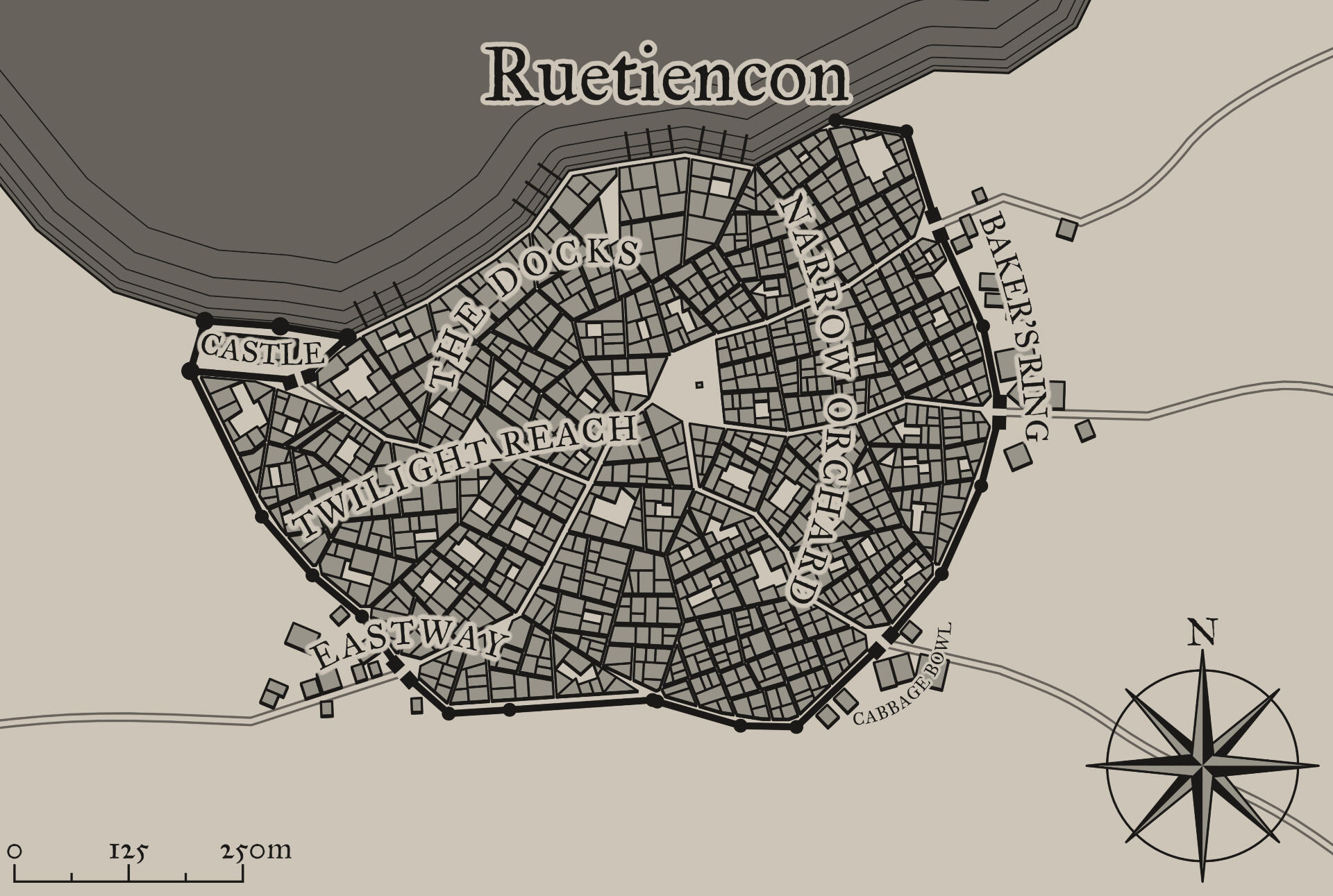
Export city, plain and simple. As mentioned in the Cerralvecas city bio, Ruetiencon is the larger export city of Melia. While Cerralvecas handles smaller and less important exports, Ruetiencon is essentially an efficient factory and shipping city for the whole of the Bay of Narrows and beyond for the rest of Findeste. It's always easy to come here for economic gain since there's plenty of jobs that all pay well and everything.
Cade
(Capitol of Melia)

While not the biggest and most grand capitol city out there, Cade serves its purpose well as a capitol city and port city to Melia. It being in the center of the country means that it has a very constant through-way traffic for all sorts of elves getting across the country for trade, recreation, or business. For a true melting pot of elves, this is the place to go. All meetings of the Grand Fey Council are held at the castle in the center of the Market Town district.There are no standard docks at Cade, instead using magical docks raised from the water via sea elf laborers. Cade isn't the biggest city around, but they practice the utmost in safety procedures due to the nature of business here. There is also a man-made Underdark entrance in the plaza at the northern-most section of the city just outside the city walls.
The Inernantian Empire
(The Melting Pot of Findeste)

Calling the Inernantian Empire the "melting pot of Findeste" really isn't an understatement of all. For all of 1,200,000 people living within this one country alone, you'd be hard pressed to not see one of every race in this place. Created over the battlefields of the Final Gambit before expanding to take over most of the western side of Findeste, this country is home to so many different sights to see and varying kids of services available.

As far as the environment goes, the Inernantian Empire is full of many different types of biomes. The green areas like around Bruiaberg (which is the capitol of the Empire) are Temperate Deciduous Forest. Wrapping around the west side is all Grassland, as is the patch to the northeast of Bruiaberg. That patch of grassland actually has a small bit of Savanna between the cities Elerallele, Aberber, and Inverkinver. Between Inner and North Inver, along the Briraberudob River, there is some Tropical Seasonal Forest, since this is around this world's "Equator" where the temperature is at its hottest. Heading down the "body" of the Empire towards the cities of Brigion and Atendorando are Taiga, the cold subarctic forests you see right next to the Tundra right beneath where cities like Camridge and Aberloch lie. The creamish color at the very bottom is pure Glacier, before going up the "tail" of the Empire leading back up to more taiga, grassland, and forests. The slightly darker green on the north end of the tail, around the town of Garanha, is Temperate Rainforest.

A more detailed look at the topography of the Empire shows how the center of the body and tail of the Empire are at higher altitudes. Most of the rolling hills average about 1600 feet, while the mountainous areas of The Fingers of Terros reach peaks of about 4000 feet on average. You can see the variance between deciduous and conifer trees, the grasslands and swamp lands, and even the small mountain ranges.

Bruiaberg being the capitol means that the Empress lives here, her being Empress Torgela Innerntia, a high-elf fire genasi and the head of a prominent genasi family as of the year 1384 AFG. The county that Bruiaberg resides in is Aberlochia County, which directly ruled by her husband, Duke Sorsin Innernta, a human fire genasi that married into the family to bear the Empress half-elf fire genasi children.Directly north is Inner County, ruled by the firstborn son and 2nd child to the Empress, Prince Petrol Innernantia of Inner, a.k.a. Duke or Lord of Inner.The small, northwestern county is Bish County, ruled over by Marquis Orville de la Costa, a half-orc whose family closely worked with the Innerntia family for generations after the Final Gambit.Directly east is the Innermainve Earldom, ruled by the Prince Petrol's firstborn daughter, Countess Genevieve Innerntia of Innermainve. Inver County is the next county east, ruled by the Empress's firstborn daughter, Princess Petra Innerntia of Aberlochia, also known as the Marchioness or Lady of Inver, while the Alisia Region just north of Inver is ruled by her daughter, Countess Mercedes Innerntia of Alisia.The eastmost part of the body of the Empire is Sequevilrio County, ruled by Marchioness Aiwin Thenes of Sequevilrio, a sea elf whose tribe controls the Bay of Shallows (the large body of water that separates the Empire and Caltaurum from Netrodino and Melia).Travelling down the body comes the Noblanilia Territory, which includes the land around Innergor, Siecanueda, and Alcanzares. This is ruled over by the Empress's 4th child, Prince Callum Innerntia of Noblanilia, also referred to as Marquis or Lord.Just south of there is Camridge County, ruled by the Empress's 3rd child, Prince Roy Innerntia of Camridge, also referred to as Marquis or Lord. His 4 children rule over the next 4 counties, travelling west to east along the bottom curve of the Empire, those being Abercychia County, Aberkin County, China County, and Torgela County respectively. His children are Earl Phillip, Countess Cynthia, Countest Lorraine, and Countess Torgela Innerntia, respectively.Travelling north through the tail of the Empire is the Tartesedo Baronry, ruled over by Baroness Sarasvati Parvati of Tartesedo, a black dragonkin woman whose family from Donvidia proved to be useful, respectable, and loyal comrades to the Empire during some altercations after the Final Gambit earned their family a place in the Empire, if only as a simple Baroness.The county that takes up most of the center of the Empire's tail is the Amecamugela County, while the area just to the east is the Alvez County. Both are ruled by the Demarco family, Countess Emilia Demarco of Amecamugela and Viscount Emilio Demarco of Alvez being the former wife and a 5th son (albeit the first born) of Earl Phillip of Abercychia. They are a satyr and wood elf from Melia who married into the family but got divorced due to Emilia not being able to bear anymore children after Emilio. The relations are good with the family, even if Phillip has remarried.
Going even more specific, the buttons below will take you to maps and details of certain cities of any interest within the given country.
Empire Body Cities
Empire Tail Cities
Veruesamane
(Gateway to Southern Netrodino)

Veruesamane is another immigration city specifically for Netrodino. Alastia Land, that small section of Netrodino by Melia that's separate from the main country, has its own port that most Netrodino travelers use to get to the tail of the Empire, and this is always the first stop they go. Not much else can be said for Verusamane that can't be said for the other tail cities: large wood-elf population and culture around these parts, and the city is fairly dense with an amicable environment.
Udeca
(To the Southern Islands)
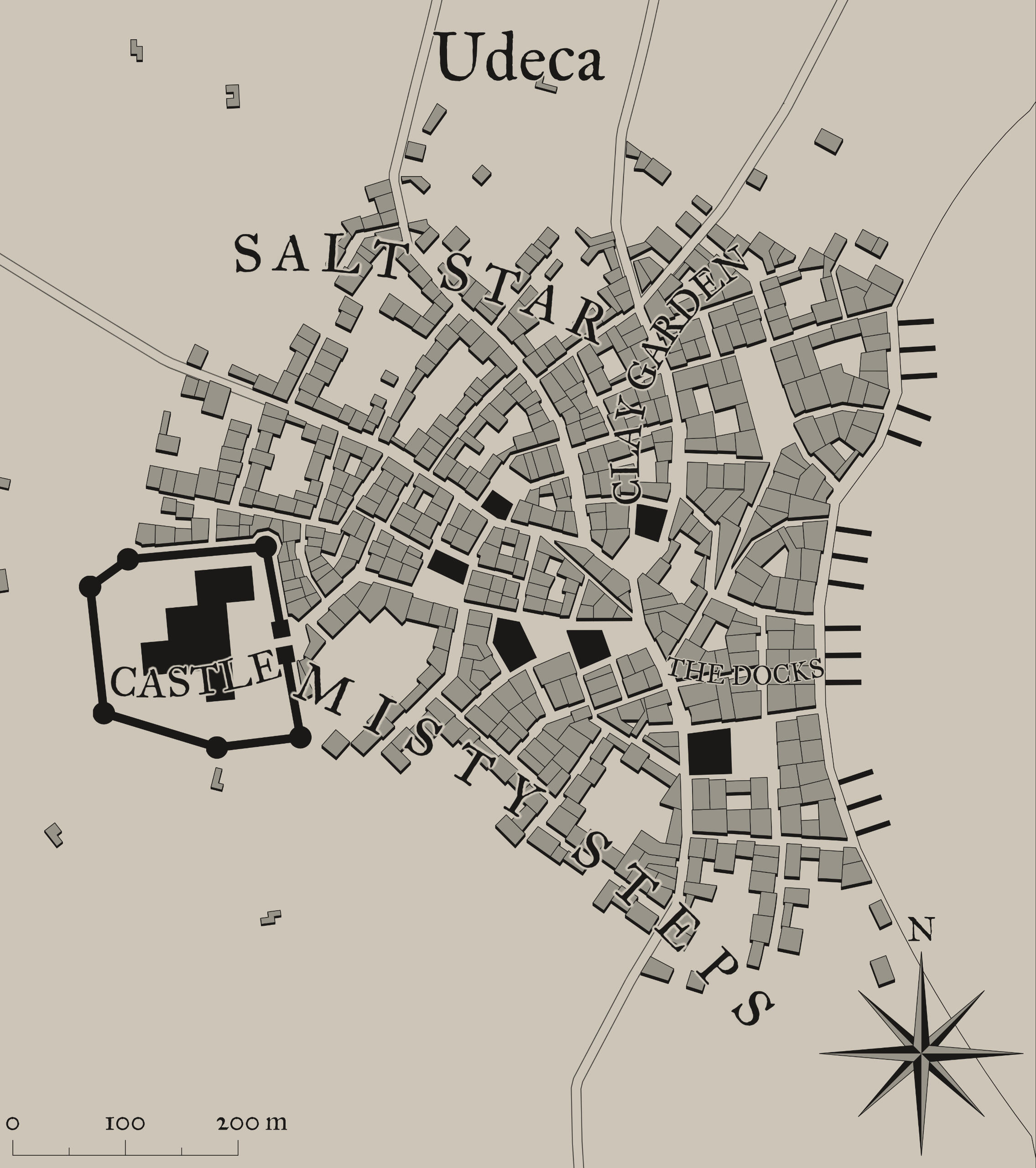
Udeca is another port on the southern coast of Findeste, so it isn't nearly as busy of a port as something more inland. However, it is the only way to get a paid charter to take you to the Empire's southern islands between the tail of the Empire and Dreila. Those first three that are collected around each other are the Lubia Islands, while the one farther south on its lonesome is Cotosia Island. Both were annexed and owned by Alvez County. They're thought to be dens for some interesting creatures, but the islands aren't often ventured to for solid confirmation of these facts.
Barrios
(Town of the Fine Arts)

At first glance, Barrios is just another one of those larger towns with a decent population and tons of variety that's on the given path to more important cities; and you're right, for the most part. Barrios is also what some call the "Art Center of the Empire", and it's a home to a multitude of different museums, art galleries, cuisine, music halls, and theaters. You can experience so many different cultures' worth of the fine arts by just talking down a block in Barrios. It's certainly the place for a romantic getaway among art fanatics.
Siecanueda
(Top of the Tail)

Considering most people wouldn't be likely to make the long trek all the way down the body of the Empire to reach the tail, the quicker option would be traveling by sea. The closest option would be taking a ship from Sequevilrio to Siecanueda, and then after a quick trek through Alcanzares just east, you're getting into the meat of the tail of the Empire. Unfortunately, it's a very crime riddled city, so while you may survive the boat ride from Sequevilrio to Siecanueda, making it THROUGH Siecanueda can be a whole different ordeal.
Amecamulega
(Wood Elf Central)

Home to Countess Emilia Demarco, the whole county is run out of this city by her, and it has attracted quite the wood-elf population. It's a very natural city in comparison to most others in the empire, taking on wood-elf inspirations. More wood is used than most other resources, and the city is beautifully decorated with various blossoming trees and other wood elf customs despite being initially structured after a standard Empire plan. Being home to the countess also means there's a extensively large population compared to most Empire Tail cities.
Sasas
(The Factory City)
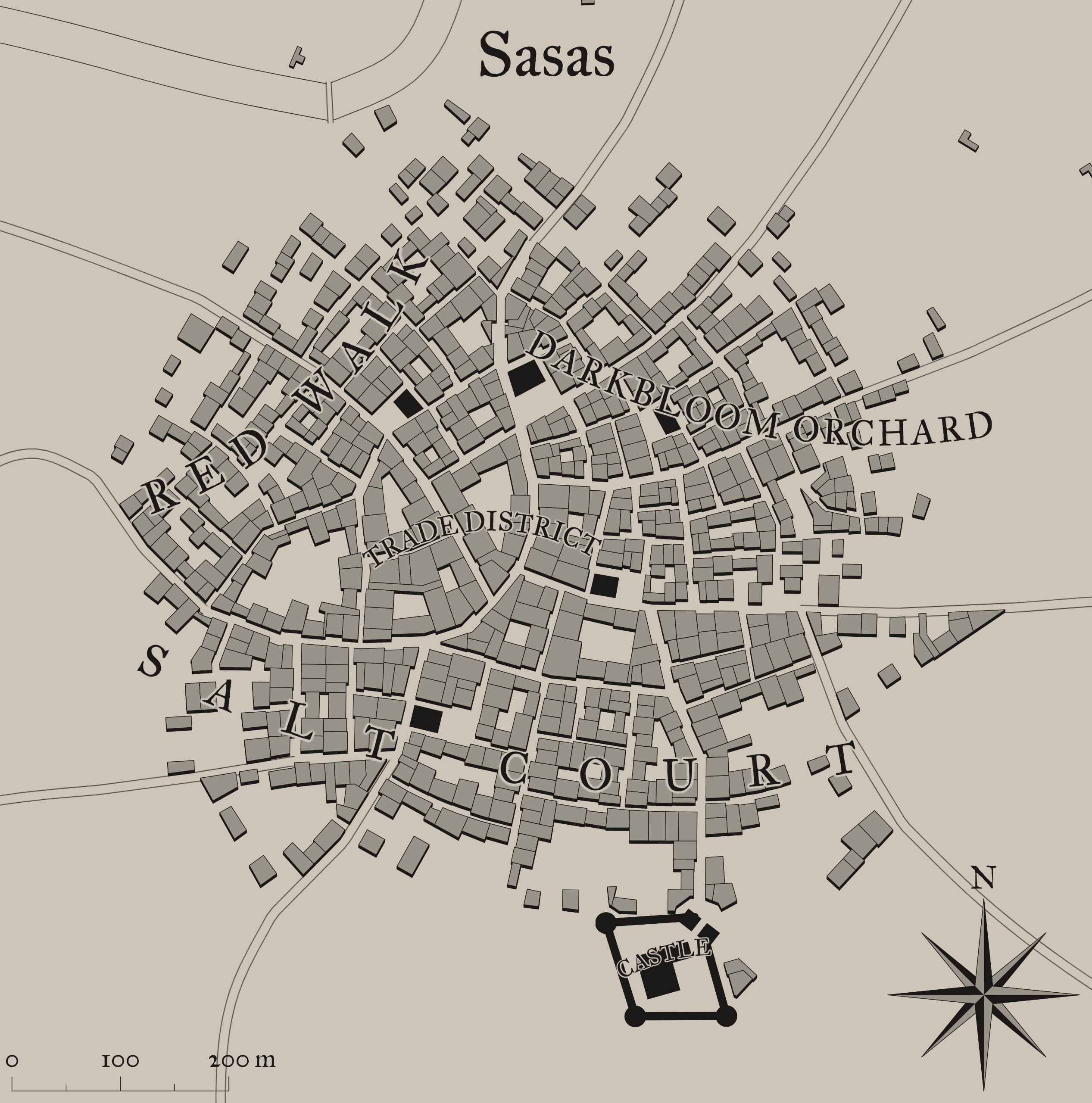
First thing to note: the castle in Sasas is an old remnant of Empire history, but it has since been repurposed as a factory for a large amount of product creation. Its different levels reach far underground, and plenty of waste products are created and burned here, making the Sasas environment more smoggy than normal. The rest of the city matches the factory, being a more steam-punk dystopian city in the Empire's list of cities. Dense populations, all industry focused on the factory run by a group of business leaders that appeal well with Prince Roy and his ex-wife to allow this sort of treatment. Most people just turn a blind eye to any bad doings here, but most of its issues aren't known to the general public, let alone to the rest of the Empire or Findeste. If you go there, just keep it quiet lest you be punished for speaking out of term...
Alvez
(Gateway to the East)

Whether taking the land route from Driela or sea route from Melia, Alvez is another melting pot of sorts, combining Empire customs with wood elf and high elf immigration. It's another large immigration city, densely populated, the usual sort. Due to Alvez County and Amecamulega County being run by Prince Roy's first wife and son, a satyr mother and wood elf son, this part of the tail of the empire is often seen as "Little Netrodino".
Torgela
(Last in Line)
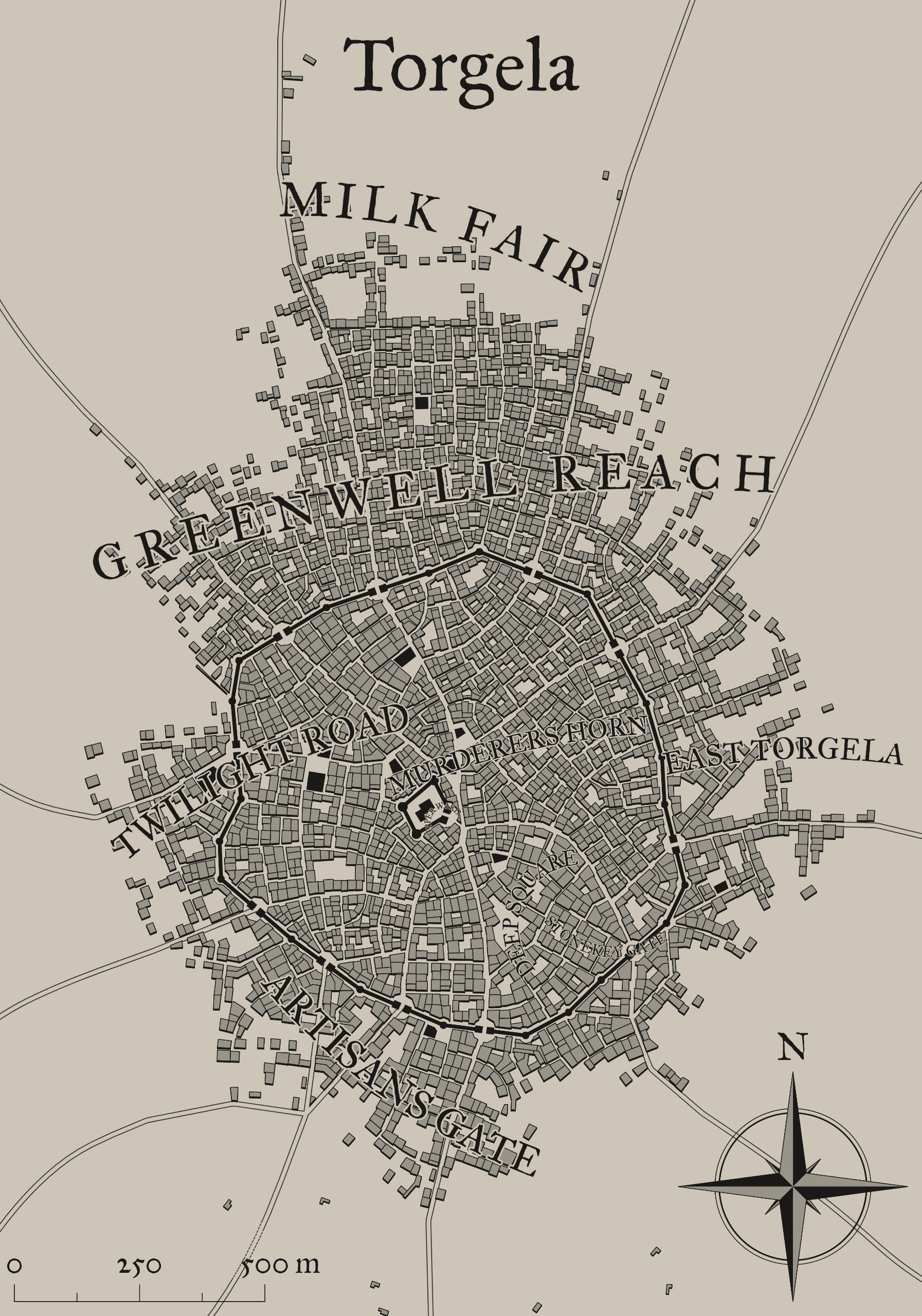
The last county and city of the tail, Torgela County and Torgela are ruled by Countess Torgela Innerntia. The county, originally part of China County was made at birth of the new daughter to Prince Roy, him insisting that it be named after her for her to rule. She was always his favorite, and of all his children, she was easily the most trustworthy. This is why her area is farthest from Camridge, so the two of them can sandwich in the efforts of her other 3 older siblings. As for Torgela as a city, the climate is instead of tundra more of a taiga, the city being not as dense as the others of the tail, with a more moderate climate rather than just cold and snow. Overall, just a city on the main path to Melia and Dreila.
Terteboltab
(The South of the South)

China County and Terteboltab are ruled over by Countess Lorraine Innerntia, and it's essentially another Avenverraf. Hugely dense population in a large city in a tundra environment. The only difference here is that it's a port city, which is significant because not nay ships sail in the icy ocean around here. The only way to get to Sagelnia Island, the island just south of Avenverraf and Stapton, is by riding a specific ferry from Terteboltab. Very few people go tot he island, and the ones that do tend to keep shut about what they witnessed there. Plenty of rumors float around, but there's only one way to confirm what it is.
Tartesedo
(Dragon Land)
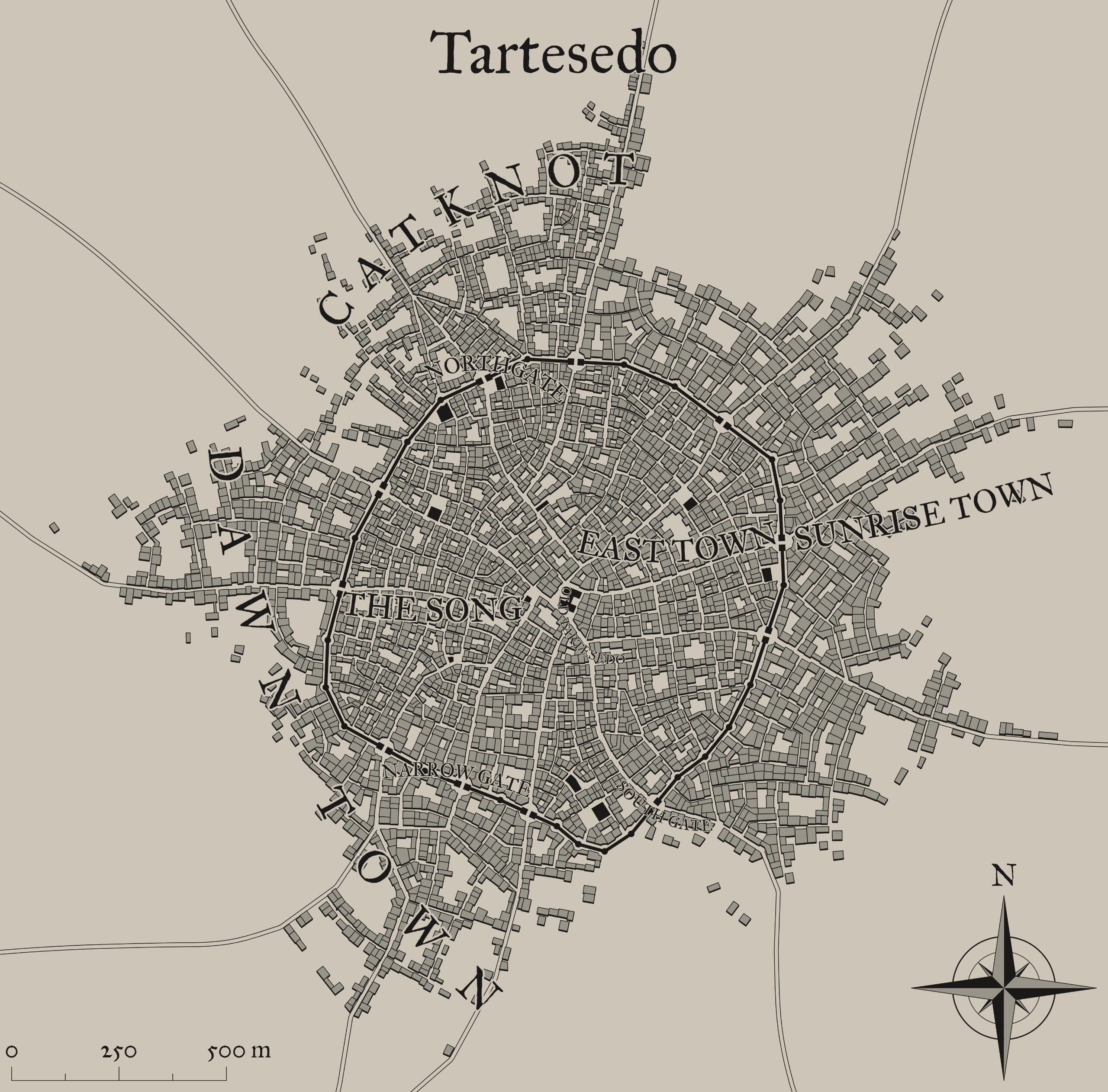
The Tartesedo Barony is often referred to as "dragon land" for two main reasons. One, Baroness Sarasvati Parvati being a black dragonkin rules over the area, and her family's history with the Innerntia family throughout the years makes the dragonkin race well respected in the empire. Two, because south of Inhircych, between the Killanverge River and Nodu Creek, there is said to be a full-fledged dragon den somewhere in that area. Young dragons can be seen on occasion flying over the county, and Tartesedo made itself a bit of a tourism spot to learn about the history of dragons and dragonkin.
Aberloch
(Next in Line)

Going from west to east, from Camridge and Avenverraf, the next up on the list is Aberloch. In the Aberkin County ruled by Countess Cynthia Innerntia, Aberloch is another wintery town with a pretty sizeable population and a whimsical out look on life. The same could be said for all the tundra towns, in all honesty. Not many people take the southern land route to get from the body of the Empire to the tail (outside of Paladins and Clerics on pilgrimage), but at the very least, the people are all kind and inviting.
Camridge
(Gateway to Tasinland)

Camridge is the designated "immigration city" for Tasinland, along with being the main city of Camridge County and hosting Prince Roy Innerntia. From there, the prince oversees not only his county and Tasinland immigration, but also the 4 counties that wrap through the tundra and ice leading up the tail of the empire. While those counties are ruled over by his children, they're moreso ruling over them as their "test period", his seeing how effective of rulers they can be. At anytime, he can seek an audience with the Empress and simply have their title stripped and added onto his own title.
As to be expected from an immigration town, the standard "one-year-live-in" rule applies as well, and you can find a decent amount of Tasinland trade going on within the town.
Avenveraff
(The Odd One Out)

Avenverraf is certainly an odd case among these tiny counties along the tail. It's the sole city of Abercychia County, ruled over by Earl Phillip Innerntia. Despite the frigid temperatures that far south, Avenverraf is one of, if not the densest city in all of the Empire, mostly due to Tasinland immigration. The city itself is actually quite pleasant and large, easily able to accomodate such a large population. It's just not the first thing you'd expect when you hear of a town close to the south pole. It's not just 10 igloos with a family in each, it's a fully functioning, bustling wintery town in all aspects. Some people have grown fondly enough of Avenverraf to call it "Christmas Town" due to the general pleasant attitude and everlasting winter.
Brigion
(The Throat of Aquos)

Another city down the Strait of Gaoll, Brigion is the first city that really leaves you open to the southern sea in the nook of the "tail" of the empire. As a city, it's another densely populated port city with trade and all, but the open water it leads to down south is a new story. It's most often referred to as The Throat of Aquos, and it's another one of those "natural disaster" spots thought to be a result of the gods' interference. The Throat of Aquos is an equivalent to a "Bermuda Triangle" of sorts, notorious stories about shipwrecks and all to those who sail its seas. While Aquos is believed to have done these herself back in the BFG, the main goddess attributed to these is one of her daughters, Umberlee the Wavemother. She is more often known as the Bitch Queen, and she's seen as a negative deity that one must pray to for hopes of safe travels across the Throat of Aquos when necessary. As a result of these legends, the Abermordia Islands (the two islands in the Throat) are rarely visited and have no documented towns there.
Innardaugled
(The Straight of Gaoll)

As far as the main water routes go in Findeste, just to the south-western side of the Bay of Narrows leads down the Strait of Gaoll, and through this straight is what's known as the Inner-Empire Ferry. While plenty of ships travel through this strait, the Inner-Empire Ferry is a specific ship that through the power of Ambies, it quickly transports you from Innardaugled and Alloyorea in about 2 hours time. Innardaugled is a very busy port city because of this, very much an easy place of travel. For a real world equivalent, think of it like Grand Central Station in New York, NY...just with ferries instead of trains.
Aten
(City and Game)
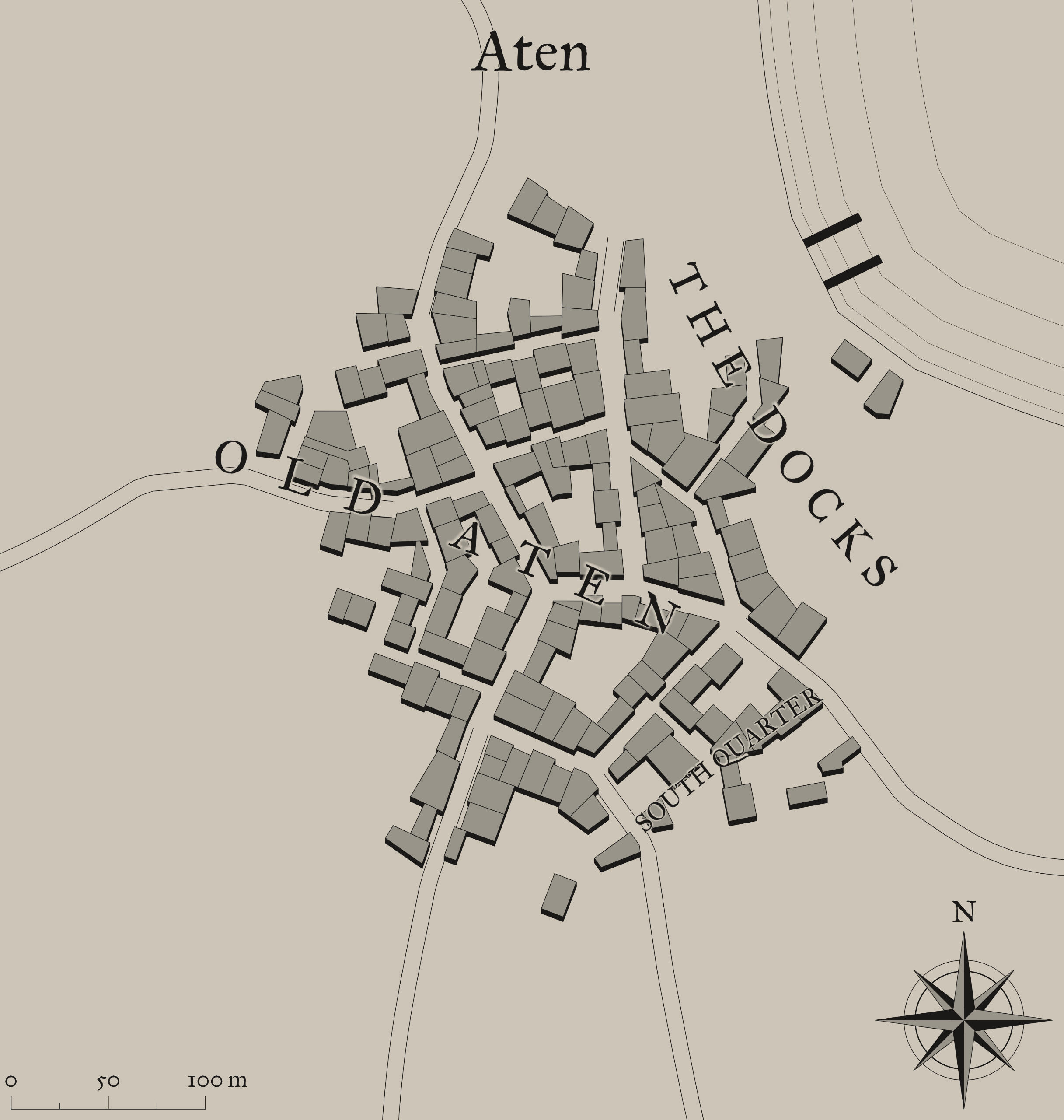
Aten is another city on the Strait of Gaoll, just north of the Throat of Aquos. However, Aten's main "attraction" so to speak is the island directly east of it, part of the Noblanilia Territory simply called Aten Island or Game's Island. It's a controlled environment specifically for game hunters, seen as a paradise and any hunter's dream. Through magic and Ambies, this island is sold as a luxury hunting area only available to the fattest of wallets and bravest of big game hunters to be able to find some amazingly unique creatures to hunt and mount to your wall should you be able to make it out. Everything from young dragons with their breath weapons to even savage bugbears and other things. It's a paradise and hell depending on what happens once you arrive there. For more details, visit Aten and seek out any tourist spot to find out how to get to Game's Island. Aside from that, Aten is just another simple port city with a decent population and tourism in itself.
Kirk
(Going Down South)

Another stepping-stone city, Kirk is coming off of the southeast of Aberlahin, and it starts the main road down the eastern coast of the Empire to head south towards the tail of the Empire. While you can simply take a ferry across the Channel of Narrows to get to the tail of the Empire from a few port cities, this leads down the walking path towards the southern, frigid areas of the country.
Nikse
(A Happy Little Detour)
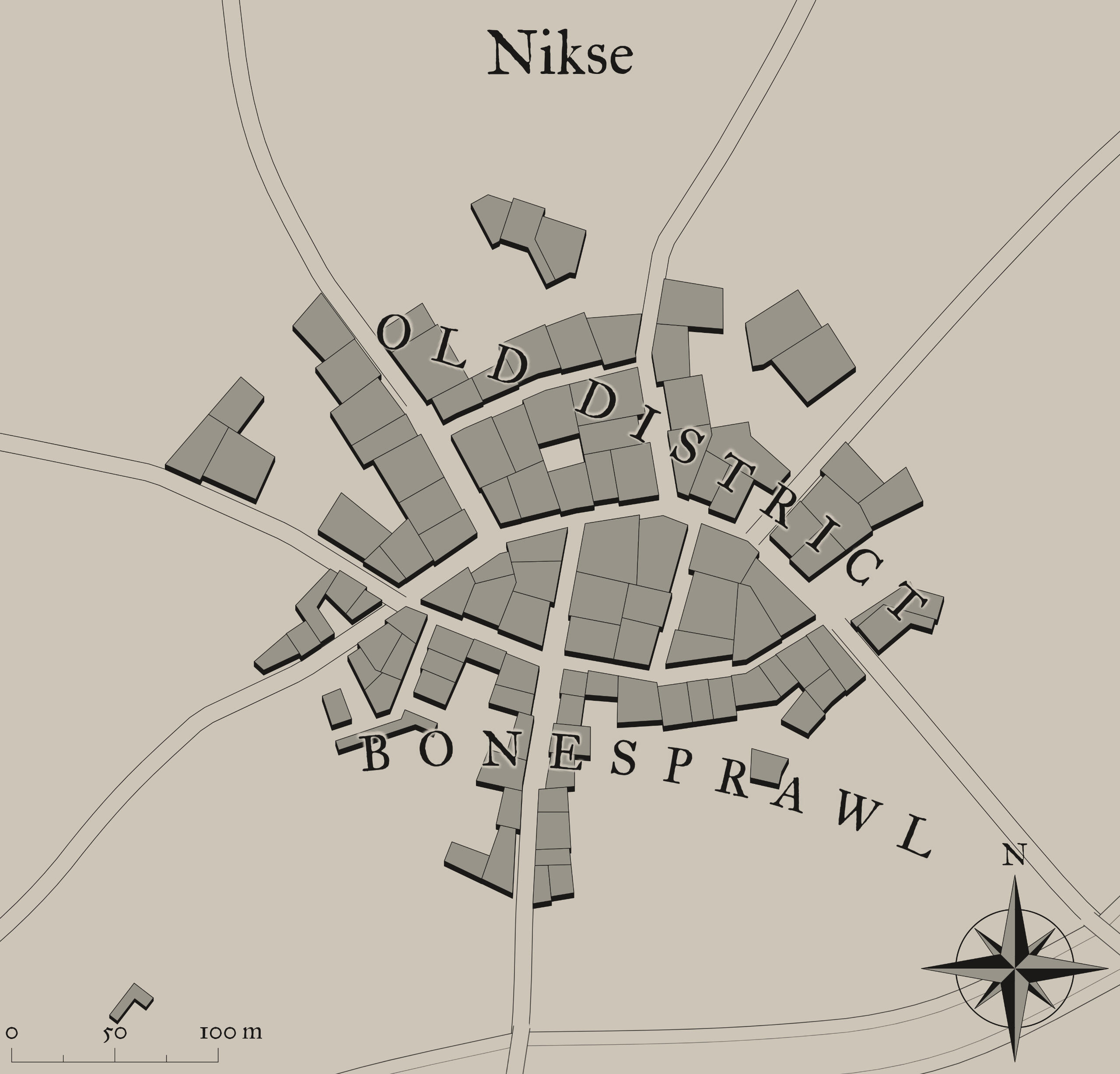
Nikse is about as "small town" as you can get. A population of not even 1000, just off the side of the main road from Bruiaberg down towards southern Barland, hospitable people that know anything and everything in their own town...it's a country life's paradise. The most important thing about the town is the All-Faith Shrine, a large church/community center where free religious practice is encouraged. While most places have dedicated churches to specific deities, the All-Faith Shrine is a place where all races can express their free, religious beliefs of any and all gods they choose. It is often a spot visited by young paladins on their Pilgrimages, learning that while they pledge their faith to one single deity, they should respect the deities of all.
Innerkin
(On the Road to Barland)

Innerkin is another "stepping-stone" city, the middle of the road between Bruiaberg and the border to southern Barland's border city of Yoznika. It's also the immigration city for Barland and Tasinland natives. Nothing too spectacular about it, it's just a city that's there.
Bish
(Gateway to Walden)
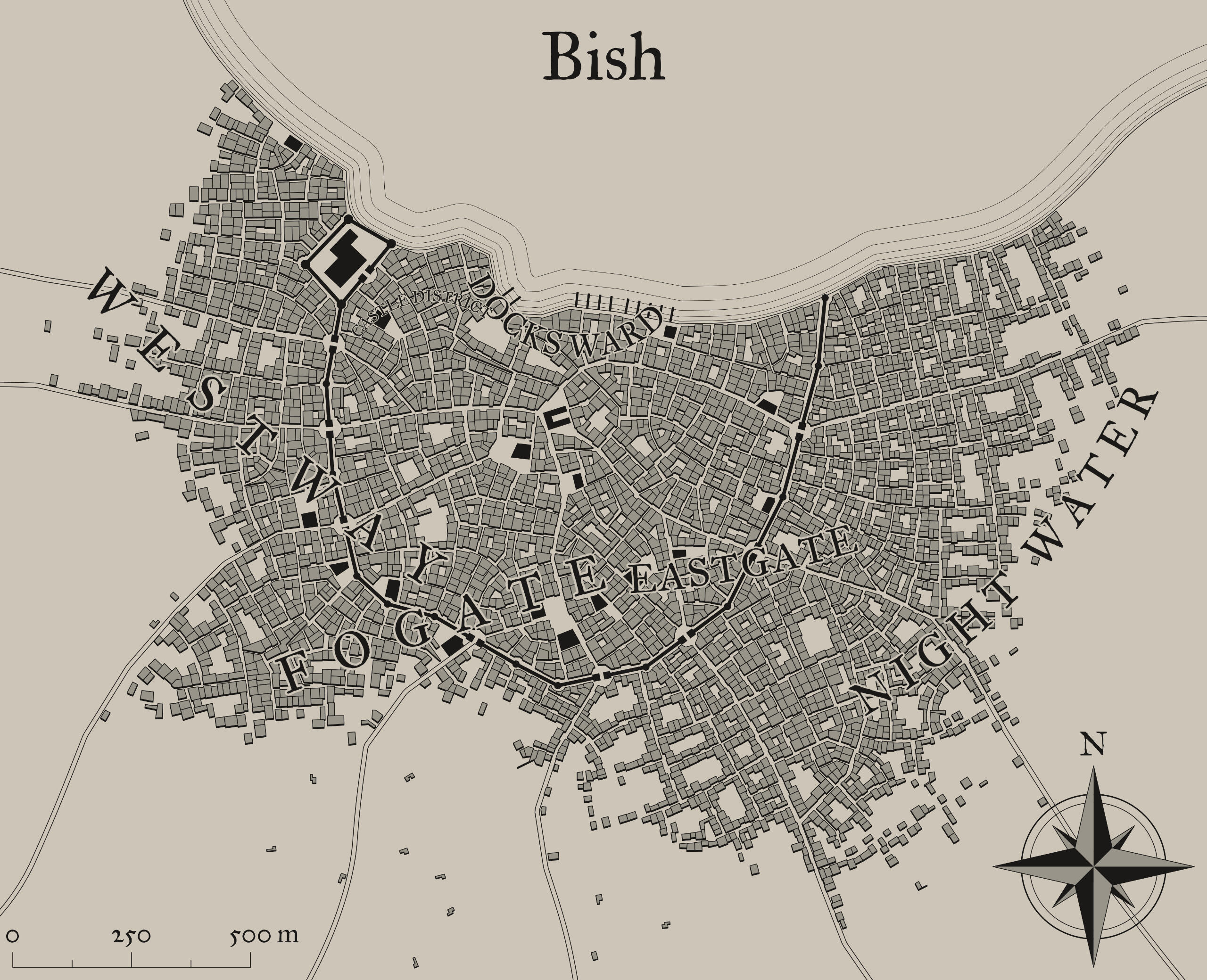
Bish is a very large port town to the north, right at the border to Walden, a primarily human country. It's moreso known for its fishing than travel, but it's a very large town that serves as another "required living area" for immigrants from Walden, as well as for inter-country trade. It is home to Marquis Orville de la Costa, who is a very well known diplomat who negotiates exclusively with Walden and ensures peaceful relations with the humans of Walden.
Inner
(Rainforest of the Empire)
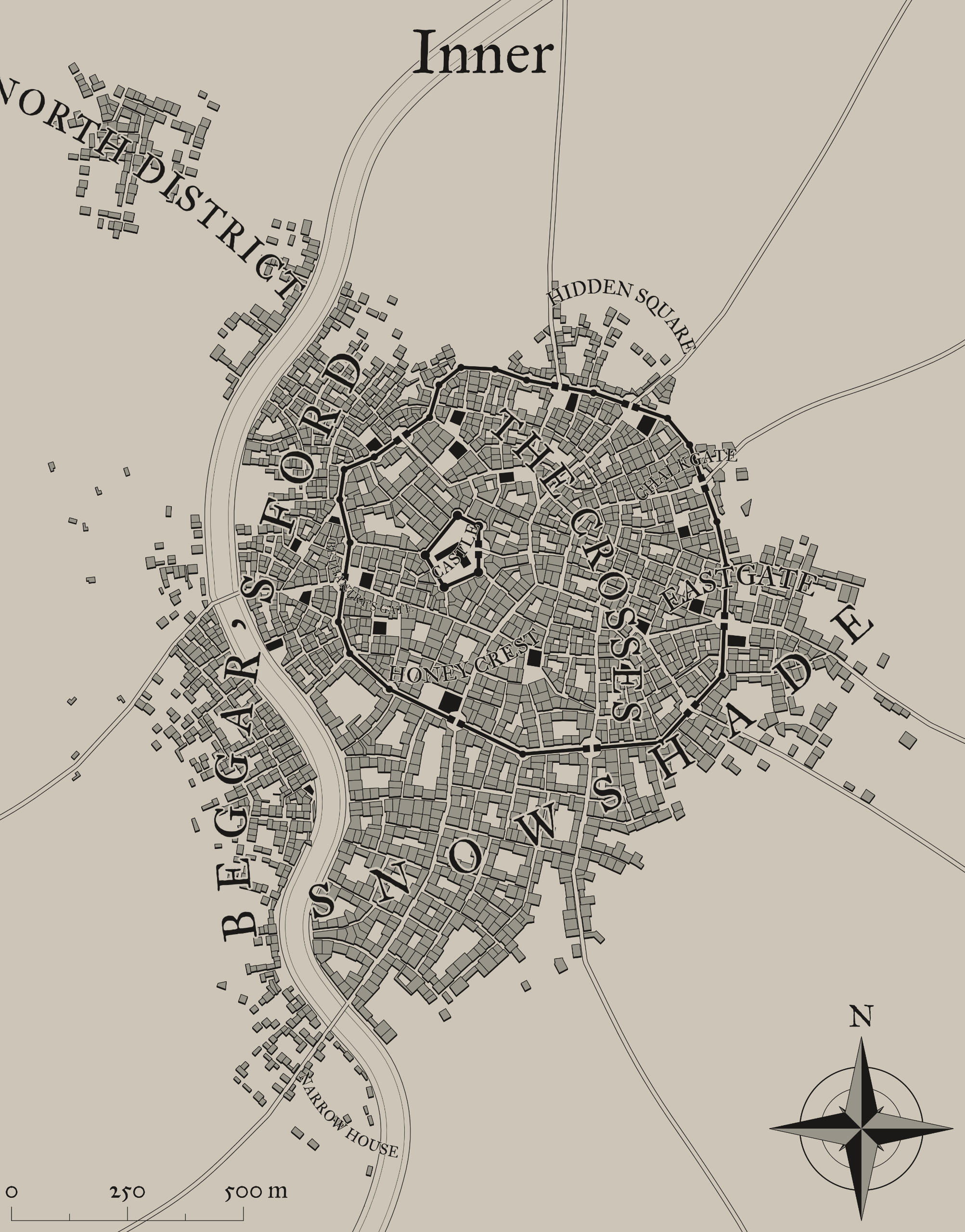
The only proper tropical rainforest area of the Empire, Inner is a proud military town. The obscurity of such a biome allows for easily obscured military operations, training, and storage for any sort of massive weaponry. Because of this, Inner is not a frequent area for visits. Those that live there are military and their direct families only, and they are not permitted to leave the city except under official business or emergent circumstances.
North Inver
(Half of History's Whole)
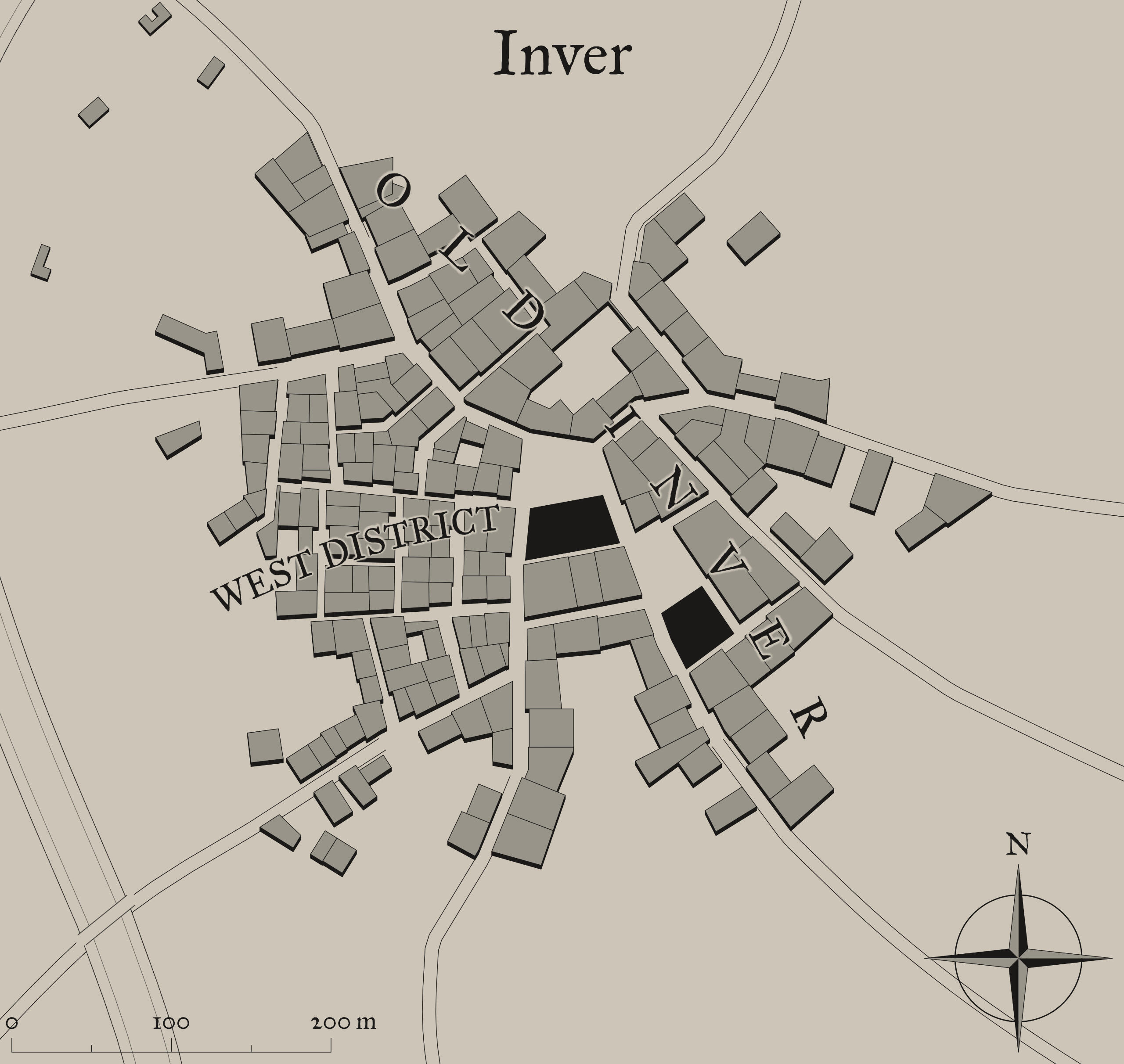
As stated in East Inver's town bio, this is the original Inver, the one where the old king once lived before his brother left with his supporters. The town is old and dense, but still quite lively and well kept for the ages. The main thing to note of is the Monarch's Museum, a history site that holds everything about all the monarchy that's ruled over the Innernantian Empire to the present day.
Inverkinver
(To the Hand of Terros)

Inverkinver is in the middle area on the border of the Empire and Caltaurum, and it's seen as the town before the entrance to the mountains at the border, known as the Fingers of Terros. It was long theorized (and later turned into urban legend) that when high elves and humans fought for land before the Final Gambit and the powers of their Ambies, the god Terros warned them with a powerful fist, rising through the crust of the earth to form these mountains. It was an idea to form a natural barrier between the two races so that their fighting over who gets what land would be quelled easily. The legend is only really told and researched by those who live here.
Abercanaid
(Liveliness in Peace)
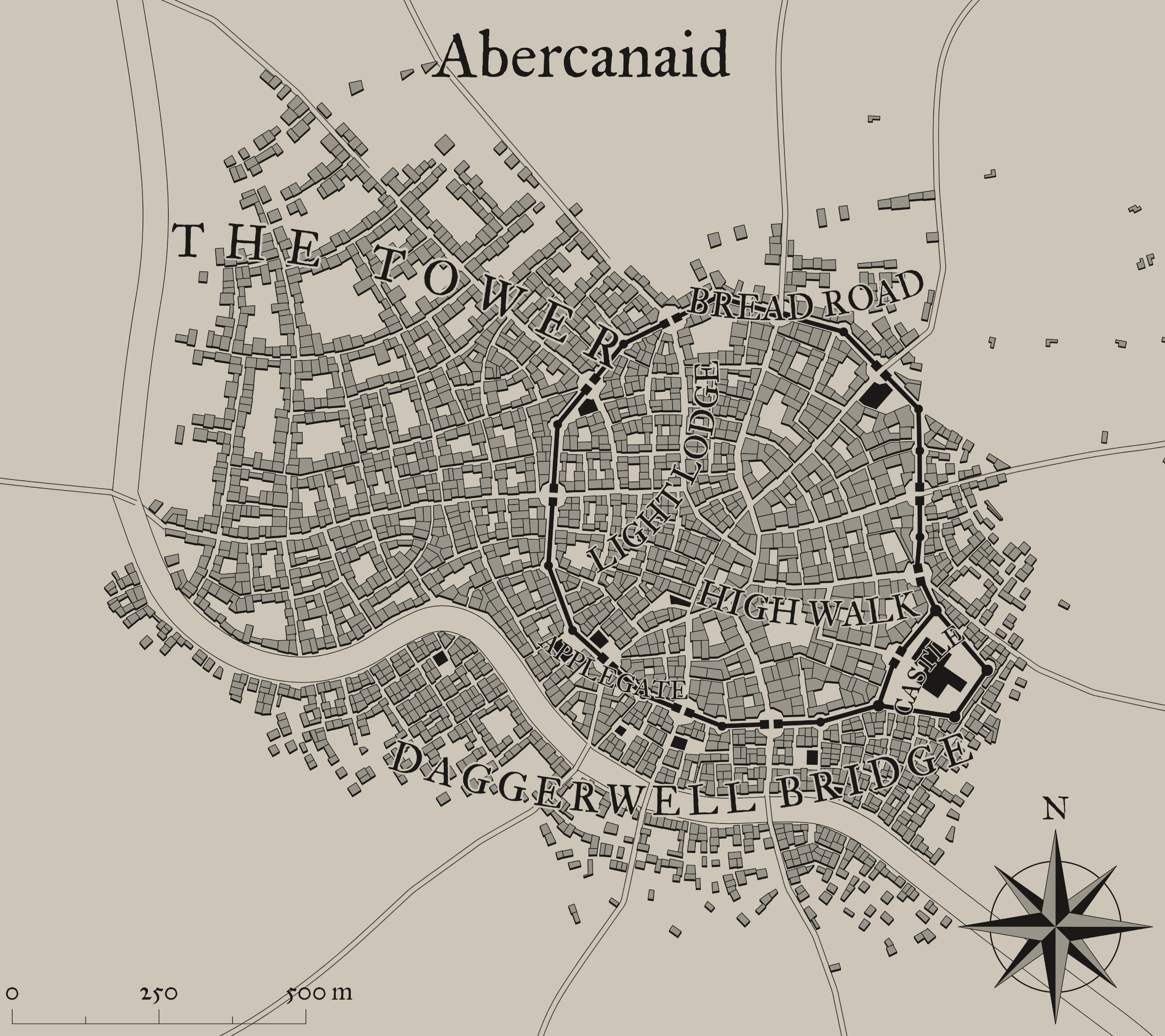
Abercanaid is another "border living town", one of the towns between Caltaurum and the Empire where immigrants from Caltaurum must register to become a citizen and live for a minimum of one year before they're allowed to move on into the rest of the empire at their leisure. Due to the mountainous areas that Inverkinver reside in, trying to do that there is not very hospitable, which is why this area is further inside of the Empire than other cities like this, like Hertavilvec.
Hertavilvec
(Sister to Traid)

Hertavilvec is the larger border town between the Empime and Caltaurum, and while Infiwavenner is more of a trade town for fast and easy business, Hertavilvec is more of a residential town. There's still plenty of business, but Hertavilvec is usually the first place anyone emigrating from Caltaurum comes to live in, staying here to study and establish citizenship for a year's worth of time before being allowed to move further into the Empire. Think of it like Ellis Island from New York, only you stay there for a year to get accustomed to the Empire's customs and all before moving on with your life.[City Seed: 8623596380189]
Infiwavenner
(Gateway to Caltaurum)
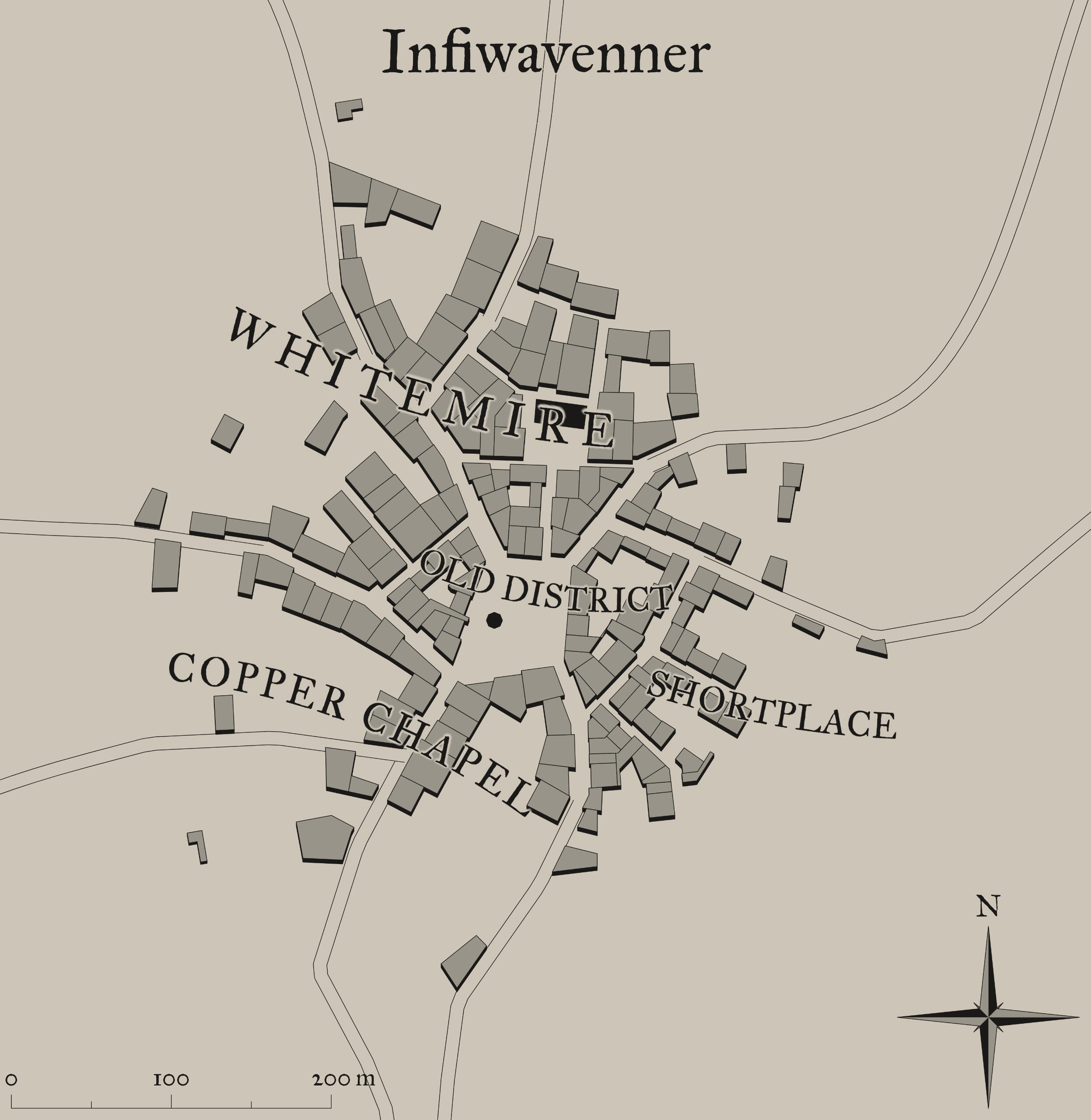
Infiwavenner is a decently sized trade town, closest to the Empire-Caltaurum border. The city works on an in-out foot traffic system. You enter through the eastern roads and exit the city through the western roads, so that trade and clearing customs is pretty easy. While sneaking across the border isn't exactly difficult, Infiwavenner acts as one of the Empire's border patrol towns, along with Inverkinver and Hertavilvec. If you want to find some authentic Caltaurum goods without going all the way there yourself, Infiwavenner is usually a good place to go for them if you don't prefer getting things directly from the source.[City Seed: 881509447]
Aberber
(Your Run-of-the-Mill Town)
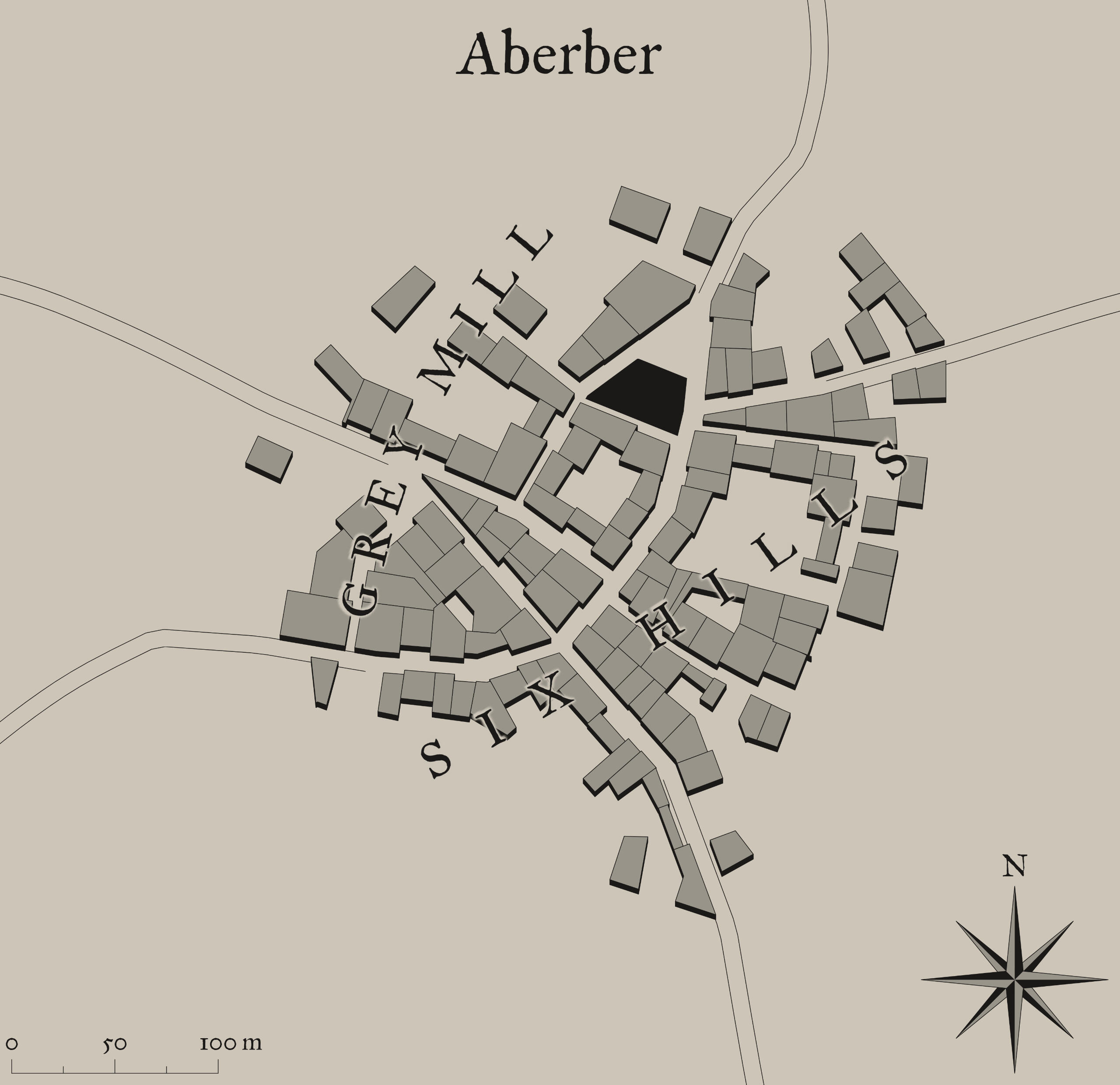
To put it kind of bluntly, Aberber isn't particularly a stand-out kind of town. The biggest thing of importance about it is that it's on the main path between Bruiaberg and Infiwavenner and Caltaurum. Not every town in the world is gonna have some stand-out attraction, but Aberber is more than your backwater town with 50 people that all know each other. It's just a run-of-the-mill fantasy town with a thousand or so folks that are friendly to all.[City Seed: 8623596380337]
East Inver
(Half of History's Whole)

East Inver is an interesting place. Inver is a two-part city, from back in the day. In before times, a previous emperor and his brother both tried to rule conjunctively, using the Northern Inver as the capitol. After a falling out, the younger brother moves to establish the East Inver as a base of operations. The full story isn't too important, and East Inver never took off as some secondary capitol like this brother imagined, hence why it's still a fairly small town even to this date. With a population of about 360, it's a small quaint town to relax in on the main route from Sequevilrio to Bruiaberg. There's a nice homey inn called the Sleeping Draught, named after a potion that eases one to sleep.
Innermainve
(Center of all Earldoms)

Innermaive is not quite as map-making as Bruiaberg or Sequevilrio, but it's a densely populated capitol of a county, and as such, it still holds much importance. It's known as the Center of the Earldoms because lots of negotiations and treaties were signed and put into effect in the Innermainve Earldom centuries ago, within the Bonegate of the city mostly. These practices still hold true; the Lowfair is now where most diplomatic negotiations between the Empire's counties being held, within the castle's walls.Innermainve is also a fairly strong military base for the Empire, Countess Genevieve Innerntia herself often overseeing the military efforts over a lot of the Empire, second only to the Empress and her personal war advisors. The rest of the city is fairly aristocratic as a whole, slums being looked very down upon. This city keeps its face clean of whatever ugliness lies in its politics and military action behind the surface.
Aberhalin
(Death's Old Door)

Aberlahin is a much smaller town than is used to be. Despite all of the space you see on the map, only a sum of about 1600 or so live there compared to older times. In the past, it was washed over by a terrible plague from a Necrotic Sorcerer's magic in the past, so the town is often referred to as Death's Old Door, as a reference from when Death came in unannounced to welcome many. That's not to say that this place is uninhabitable, however. The town isn't exactly in a thriving condition, but they receive regular aid from Innermainve when they can, and they're often seen as the slum-attachment to Innermainve as a result. Innermainve keeps is streets clean by shoveling the filth of society to Aberhalin.
The only note of interest is the old Aberhalin Castle, often referred to as the Castle of the Locust. It's a ghost facility, old rulers and military leaders leaving nothing but their bones and their spirits to reside there, so people think. No one really has the guts to set foot inside, often just keeping the entrance to the castle sealed off for fear of something dreadful lurking inside.[City Seed: 8623596380143]
Aberwythi
(Aberhalin's Better Half)
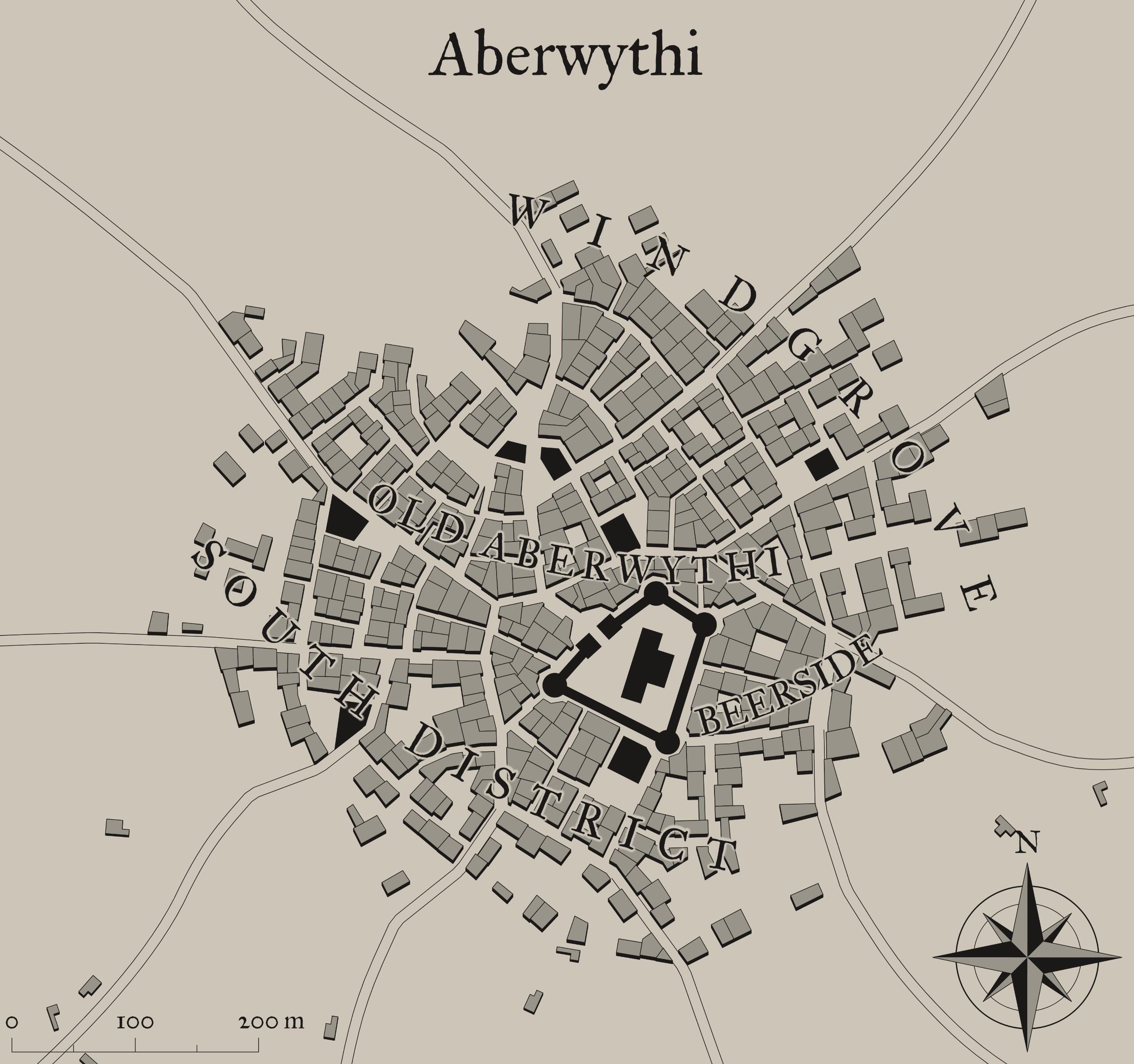
Aberwythi is where most of the surviving member of Aberhalin's old population fled to, the area originally being barren land before it was turned into another town that rivals Aberhalin. It's not as much that the people here dislike those in Aberhalin, but there's too much fear in their hearts to return to their old lands. Therefore, Aberwythi was made, and it's another relatively small-medium town in the Empire. It now has a population about about 6000 or so, and due to the size of the city, building had to start gaining height like with Bruiaberg and other densely populated areas in the Empire.
The Old District is a small area hosting a large government building, meant to host representatives of the eastern side of the body of the Empire (meaning representatives for Alicia County, Invery County, Sequevilrio Country, and the Innermainve Earldom). While Innermainve has an area like this as well, that is moreso for getting the most western parts of the Empire's body involved as well. The Old District is made specifically for the eastern body's leaders to convene.[City Seed: 8623596380194]
Invery
(The Princess's Land)

Invery is a large city for such a small county, and it's the only city of the Invery County. While the Marchioness, Petra Innerntia, owns and rules over Invery, because she is the firstborn daughter to the Empress, it's often referred to as the Princess's Land. She's often seen as your typical spoiled princess, so she tends to stay completely recluse in her castle with her servants and all. Not much else is special to Invery, aside from its artificial climate. While the area around it is nice and brisk at 40ish degrees, through artificial means like fire magic, the city is warmed to be able to host all sorts of flora that the Princess deems appropriate for her city. You'll never see a day without petals around and floating throughout the air.
Sequevilrio
(Gateway to the Bay)
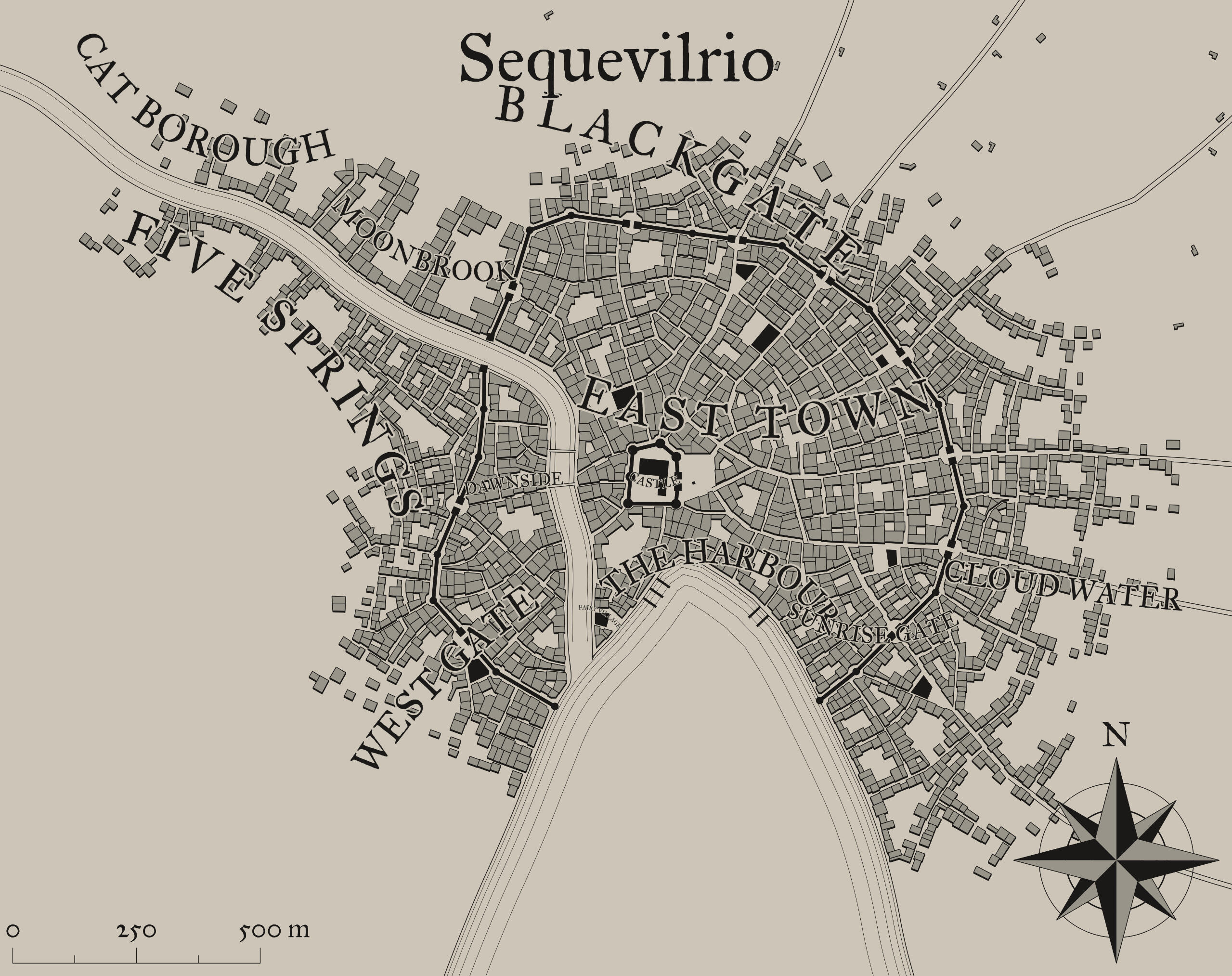
Sequevilrio is often referred to as the Gateway to the Bay, due to being located directly on the Cheles River, which leads into the Bay of Shallows. Due to its location, a large population of the city goes to sea elves and most other sea-faring humans, including some water and wind genasi. The land around the town was terraformed, and by using a mixture of machinery, magic, and Ambies, the width of the river heading eastwards was expanded and filled with water to allow ships to reach further inland for trade. Because of this, Sequevilrio is a very booming port town in the Inernantian Empire.The Harbour and Sunrise Gate are slummy-middle class areas, mostly focused on trades rather than housing. Still, those that live there tend to be working minimum wage jobs on average, the few high paying jobs there relating directly to port maintenance. East Town is more middle to upper class, and Dawnside is the most aristocratic area of the city, which is why Bay Castle, home to the Marchioness, is in the west-northwest part of the city. The Marchioness, Aiwin Thenes, is a sea elf from the Bay of Shallows, whose family has been ruling the Sequevilrio County for years since the previous Empress granted the title to them. The Innerntia and Thenes families have been fruitful allies to each other.
An important location to note is Baron Rhodes Apothecary, located in East Town (directly east of the castle entrance across the plaza). It's home to a Baron named Alexander "Axl" Rhodes, a yuan-ti posing as an elf and his family of assistants who sells all sort of home-made potions and magical items. It's a well known shop across the Empire that garners lots of traffic, and it's a place you could find plenty of interesting things on your journey.
Bruiaberg
(Capitol of the Empire)

Bruiaberg is (once again) the capitol of the Inernantian Empire. It's certainly a rather large city, with a population of about 25,000 loyal subjects of varying races. Even for its size, this city implemented what could be seen as equivalents to modern day apartments, with building having multiple floors to house multiple families in a single building. The very center of the city is composed of two separate districts: Old Town and Shortstair, an aristocratic area with some open plazas you can climb around to get a gorgeous view of the city from all angles. Just in the center of those two districts is the castle, home of the Empress. The rest of the town is filled with various sorts of little shops and businesses, along with tons of tenement buildings for the multiple different races that live within the city walls.Most of the town is at least middle class area, Bruiaberg being the capitol meaning that it's a very well maintained city. You rarely see slums or homeless...when they want you to. Regardless, it's a fantastic city to visit when you get the time to.
Basic Mechanics to Findeste
(Date System)
For simplicity sake, Findeste operates on a time and date system similar to ours. Their calendar is based on the calendar from Fire Emblem: 3 Houses with some name edits. Just for clarity sake:
- January = "Midwinter's Moon" - 31 Days
- February = "Heartstring Moon" - 28 Days
- March = "Koi Moon" - 31 Days
- April = "Downpour Moon" - 30 Days
- May = "Flora Moon" - 31 Days
- June = "Warm-Sand Moon" - 30 Days
- July = "Blue Sea Moon" - 31 Days
- August = "Monsoon Moon" - 31 Days
- September = "Autumnal Moon" - 30 Days
- October = "Malicious Moon" - 31 Days
- November = "Red Rum Moon" - 30 Days
- December = "Powder Snow Moon" - 31 Days
The current year of the world is always 600 years ago to the current IRL year. As an example, I'm typing this on October 9th, 2020; therefore an RP I would start on today's date would be:
"The 9th Day of the Malicious Moon, 1420 AFG"
[AFG refers to "After Final Gambit", which is explained in depth in the "To History" section. BFG would be "Before Final Gambit.]
Basic Mechanics to Findeste
(Time System)
The time in Findeste is based on our standard time system. 60 seconds makes a minute, 60 minutes make an hour, and 24 hours make a day. 7 days a week, 365 days a year. All basic stuff you should be familiar with (if you aren't, I pray for your safety). Dawn tends to be anywhere between 0500 (5AM) and 0700 (7AM), while dusk tends to be anywhere between 1700 (5PM) and 1900 (7PM). There is no such thing as Daylight Savings Time in Findeste.As far as time zones work, Findeste is one continent in a vast ocean, and it's roughly the same width as the United States with smaller time zones. You can see the different zones here and how they relate to real-world time zones.

In case it's still confusing, let me make it simpler. My personal time zone is the Eastern Time Zone (EST), on the east coast of the United States. Empirical Time in Findeste is the exact same as Eastern Time in the US. As long as you remember that and remember that the other time zones are 1 hour in difference respectively, time in this world should be pretty simple.
Basic Mechanics to Findeste
(Monetary System)
Money is always going to be something to think about in fantasy worlds. This time around, it will be largely based on the coin system in Dungeons and Dragons, 5th Edition.Copper pieces (Cp) are the lowest currency. While relating them to USD, they're about the equivalent of 10 cents ($0.10 USD).
Silver pieces (Sp) are the next step up. Think of them like $1 USD. It takes 10 Cp to equal 1 Sp.
Electrum pieces (Ep) come next. Think of them like, $5 USD. 5 Sp is equal to 1 Ep.
Gold pieces (Gp) is the next step up. They're the $10 USD equivalent. 10 Sp = 2 Ep = 1 Gp.
Platinum pieces (Pp) are the highest coin. It's the $100 USD equivalent. 10 Gp makes 1 Pp.Various jewels can also be used as currency, the full list (and handy chart to better visualize the coins in relation to each other) are at the button here:
Basic Mechanics to Findeste
(Ranking System)
It is no surprise that in a medieval-like fantasy world, social status and hierarchy is a major part of society. While each race's culture may have their own specific forms of hierarchy, the main basic one (shared between humans and high elves) is the basis that most other ones in this universe are given. Here, I'll be giving you a quick cheat sheet on how Findestian Nobility works. It is somewhat based on British nobility, while it may not be 100% accurate to it. Keep in mind that these are the titles for most places in Findeste. Other countries with differing cultures may have their own social structure apart from the norm.Queen and King are the top rank in all of Findestian nobility. While some places may use the terms Empress and Emperor, the terms are synonymous. Aside from being the "top-dog" of that country's hierarchy, they are the only ones with the power to grant any of the other titles. Do not confuse the Queen with Queen Consort, for she is simply the wife to the King and has no real power.Prince and Princess refers to the direct, blood related child of the current Monarch. If someone is married to a Prince or Princess, they are addressed by their spouse's name (Ex. If Tiffany marries Prince Chad of Walden, she is not "Princess Tiffany". She must be referred to as "Princess Chad of Walden" if she does not have any other titles.) That is overly formal, but correct should you want to use the highest title for them.Duke and Duchess are next up. Children of the Monarch are typically granted this title either of age 24 or whenever they marry, whichever comes first. This can also grants them rule over the counties directly around the capitol in the respective country, based on the Monarch's choice.Marquess and Marchioness are next, referring to those chosen to lead more distant counties among the country, particularly border counties along national borders. While functionally identical to the role of Duke and Duchess, the closer a county is to the capitol, the higher regard it is held, the counties directly next to the capitol being held in such a high regard that Duke/Duchess and Marquis/Marchioness are treated as separate titles (Duke being superior to Marquis).Earl and Countess are next, usually referring to the child of a duke/duchess or marquis/marchioness. Typically when their parent passes on, they take the role their parent once had.Viscount/Viscountess is next, referring to the child of an earl/countess. It's just another step down in the hierarchy for counties specifically.Lastly, Baron and Baroness are titles awarded to those that are typically seen as trusted "right-hand men/women" to the country. They're often given out as a reward for meritorious service to the country, and they have no possibility of ascending the hierarchy without means of marriage.The term Lord/Lady can be used as a substitute of the full title for Baron through Marquis (and respective female counterparts).
Ambiguities of Findeste
(This World's Unique "Powers")
After the Final Gambit, an important event in Findeste's history which introduced a new form of power to the peoples, the powers granted to the races of Findeste slowly started to manifest themselves. After the centuries of countless generations co-mingling and mixing genes, these powers end up in some way or another in every living being on Findeste, manifesting in some way or another. Due to the seemingly erratic nature of who has what powers, scientists have deemed these powers to be referred to as Ambiguities, or Ambies for short. Think of them like Quirks from My Hero Academia, or Semblances from RWBY.One VERY important distinction to make is that Ambies are not the same as Magic, even if effects may be similar. The easiest way to differentiate them are how you get the power you're using. If the power is with you from birth or develops as a part of your race, it's an Ambi. If the magic is granted to you by third party, it is still magic.

Artwork of Axl Rhodes done by Aru Kioki on Facebook.To better explain "Ambies vs Magic", meet one of my original characters, Axl Rhodes. Isn't he adorable? He also happens to be half-drow (meaning he has a human father and a dark-elf mother).
- Dark elves typically have different traits from other elves (as is evident from D&D 5e). They have their own form of racial spellcasting, being able to use the cantrip Dancing Lights at will while also learning other spells as they mature (or in D&D terms, level up). Axl, being a half-elf, inherits this trait from his drow mother. THIS IS AN EXAMPLE OF AN AMBI. He was born with the ability to use this power due to his genetics containing the blood of the gods that graced the lands at the Final Gambit.
- Now, Axl is also a Trickery Cleric in the world of Findeste. He devotes himself to the lesser god Leira, goddess of illusions. In return for his devotion to her, she allows him access to spellcasting through a holy symbol devoted to her. THIS IS AN EXAMPLE OF MAGIC. Since Axl had to become a Cleric in service of Leira in order to get access to spellcasting, any spells he casts as a Cleric are your traditional "Magic".IF USING AMBIES IN A CAMPAIGN, treat a PC's racial features and miscellaneous features as their Ambi. A lot of races in Findeste are a result of Ambies, and even a variant human could write off something like Alert's "enhance alertness" as an Ambi for simplicity's sake.
Ambiguities of Findeste
(Powers and Society)
A lot of Ambies tend to be weak, mostly due to being passed down through many generations. Still, some stronger Ambi users tend to be born every now and then, so knowing who has what Ambies is definitely important. When an Ambi is discovered in any given individual, it must be demonstrated and logged with your local government for storage in local archives. While the intention behind it is for safety reasons, many people still disapprove of this, often calling it an invasion of privacy. As a parallel, think of it as an unwilling donation to a blood bank just so the government always knows your blood-type; there's no stated intention to use that information for anything else other than records, but others are worried that your blood will be used in ways it was not intended for.
One thing to address with regards to the last page's example of Ambi vs Magic (featuring my OC, Axl) is the importance of class and race. A lot of races come to be due to Ambies that are passed down from one parent, a mixture of both parents, or being something spontaneous with recessive genes (which will get discussed more on the following page). D&D 5e has many classes that all involve using magic through studying, channeling the innate magic of your surroundings, or having an arrangement with a deity.The one exclusion to this standard is the Sorcerer class, whose magic comes from a magical ancestor or sorts. Since Sorcerer's tend to get their magic as a result of magical ancestry or through some other unknown, magical means, it's the only way class can impact the Ambi. The Sorcerer's Ambi as it is referred to is known as one of the most powerful Ambies in Findestian history, and it is exceedingly rare. Because any race can technically gain it, the mixing of a rare race's Ambi along with the Sorcerer's Ambi has the potential to have enough power to destabilize a country. Sorcerers are few and far between, but due to governments wanting to restrict their movements and limit their abilities through drugs and other means, most end up turning evil and hiding away in their own dark recesses of the world.For D&D campaigns, it's fun to make Sorcerer characters (BBEG's or even PC's) as lawful evil, since the world is effectively out to get them for simply existing. Sorcerers can be an excellent plot device in a Findeste-setting campaign due to the infamy of the Ambi associated with it.
Ambiguities of Findeste
(How Most Races Were Made)
Ambies are known for various wild effects at time. One of those effects involve drastically changing one's physical appearance to the point where they evolve and grow into an entirely new race. While the world was made on solely Humans, Elves, and Orcs before the Final Gambit, current times show a lot more diversity in the type of people that you can see walking down the street at any given time. Here's a quick run-down of all the races on Findeste, and how they come into this world. Some of these will have a classification like "Life" or "Equilibrium" next to them; this will be explained in the next page on Ambies.
NOTE: While all of these are taken from D&D 5e, not all have the same lore to them as they do in the original source material. These are essentially just the playable races in this world.
Now to quickly explain - the world started with three main humanoid races: elves, orcs, and humans. Once Ambies entered the fray and got mixed amongst the wide, WIDE, gene pool, we got plenty of different races. By technicality, many of them are essentially one of these three base races who inherited a specific Ambi, but due to Ambies being hereditary, it's essentially just genetics turning one race into another. Below are the list of all Ambies that result in a new race.
Humans: Your standard humans, nothing downright extra.- Animal Ambi (Life Classification) - The Animal Ambi is the most common Ambi, inheritable by all 3 races. In Humans, it's developed to create the following races: Aarakocra, Kenku, Locathah, Tabaxi, Tortle, Yuan-ti Pureblood, Shifter, Naga, and Simic/Animal Hybrid
- Elemental Ambi (Equilibrium Classification) - Uncreatively name, this Ambi is shared by Human and Elves. In humans, it develops into Genasi of all 4 elements. The classification changes based on the type of Genasi: Fire Genasi being Fire/Life mix for Equilibrium, Water Genasi being Water/Life mix, and so on.
- Demon's Ambi (Equilibrium Classification) - The Demon's Ambi is often linked to ancient demons created by Malos, God of Death in Findeste's history. It is inheritable by Humans and Orcs. With Humans, they create Tieflings of all kinds. This is a Death/Life mixture for classification.
- Angel's Ambi (Life Classification) - The Angel's Ambi is often linked to the Goddess of Life, Vitrios. With Humans, they create Aasimar of all kinds. Fallen Aasimar are considered Equilibrium, being a Death/Life mix for classification.
- Dreamer's Ambi (Life Classification) - The Dreamer's Ambi is believed to be linked to some ancient story of a human with abilities to connect to a dream-like realm. This creates the race of Kalashtar, a humanoid that can connect to a new realm through their mind.
Elves: While originally one basic race , the introduction of Ambies made them an incredibly diverse race. Most of the basic variations of elves came to be due to physical adaptation over centuries before civilizations. The following subraces exist for elves, and the Ambies each subrace can inherit are as follows (as they differ from different forms of elves).High Elves are a form of elf with an innate connection to the arcane arts. They're your most "bog-standard" elf, not really fitting a particular region like other elves with different biomes. They're about as "standard" of an elf that you'll find in Findeste.
- Elemental Ambi (Equilibrium Classification - Like Humans, the Elemental Ambi can be inherited by High Elves, resulting in Genasi. An important distinction is that Elf-based Genasi (E-Genasi for short) are often seen as "superior" to Human-based Genasi (H-Genasi for short) due to social status and high elves generally seeing themselves as superior to humans. The classification changes based on the type of Genasi: Fire Genasi being Fire/Life mix for Equilibrium, Water Genasi being Water/Life mix, and so on.
- Solstice Ambi (Life Classification) - The Solstice Ambi is a variable-type Ambi for High Elves, thought to be directly connected to the Life Goddess, Vitrios, herself. This creates the race Eladrin, an advanced form of High Elf that has control over weather and seasons to a small extent naturally, as well as having a connection to t he Feywilds, a realm Vitrios is said to inhabit.Wood Elves are a form of elf that have adapted to wooden environments, which are plenty sufficiency across most of Findeste. They're very common to find as well, probably more-so than high elves in certain areas.
- Animal Ambi (Life Classification( - The Animal Ambi is present among Wood Elves, and it can lead to the following races: Satyr and Centaur
- Giant's Ambi (Life Classification) - The Giant's Ambi is said to be connected to an ancient race of giants, supposedly created by the gods. It is shared by Wood Elves and Pureblood Orcs. In wood elves, this leads to the race Firbolg, a sort of half-giant race that's a stepping stone between wood elves and giants of oldSea Elves are a form of elf that's adapted to aquatic environments, able to breath underwater and swim quite adeptly. Most tend to live in coastal areas across Findeste.
- Animal Ambi (Life Classification) - Sea Elves can inherit the Animal Ambi to create the race Locathah just like humans. Elf-based Locathah (E-Locathah) are much more common than Human-based Locathah (H-Locathah)
- Sea God's Ambi (Equilibrium Classification) - The Sea God's Ambi is thought to be the strongest form of Water Ambi given from the Water Goddess herself, Aquos. This Ambi creates the race Triton, an enhanced form of sea elf in this universe more equipped for deep water environments.Dark Elves or "drow" are a race of elves that retreated underground for shelter before adapting, and most tend to follow minor gods that spawned from Malos, the goddess of Death Magic. They carry the same type of society as traditional 5e drow, just with a different deity and without as harsh of an evil presence. While discriminated against by most other races, not all of them are inherently evil.
- Shadow Ambi (Death Ambi) - The Shadow Ambi is similar in origin to the Demon's Ambi (which is Human/Orc exclusive), seen as the equivalent for Elves. This creates the Shadar-Kai or "shadow elf", an advanced form of drow (in this universe) that have connected to a Shadow-Realm with direct contact to Malos herself.Half-Elves are simply the product of an elf parent and human parent, often thought to carry the best of both races while others see them as mutts. While they don't have any Ambies specific to them, Half-Elves can inherit Ambies that change race if and only if both parents share the Ambi that would be passed down.
- Example - Say we have two Earth Genasi. One is an H-Genasi, meaning they're Human with the Elemental Ambi. The other is an E-Genasi, meaning they're Elf with the Elemental Ambi. Together, they can have a half-elf child with the chance to pass down the Elemental Ambi, resulting in a half-elf based Genasi (often called HE-Genasi). Both parents have to share a race-changing Ambi in order to pass it down.
- Counter Example - On the flip side, if an elf and human with varying Ambies or race-changing Ambies have a child, if the Ambies cannot be properly passed down, then they'll be a standard half-elf. Say we have a a Tabaxi (Human + Animal Ambi) and a Satyr (Wood Elf + Animal Ambi) have a child: since neither Ambi can be passed down as the parents aren't the same race, the offspring will be a half-elf with wood elf lineage.Pallid Elves are simply children born from the union of high elf and dark elf, and due to their poor constitution and low life expectancy, they typically are unable to inherit any Ambies. They're a rare case of this happening, and any Pallid Elves that DO inherit Ambies tend to have the most minor effects.
Orcs: Your large, hulking humanoids with tusks and/or horns in standard fantasy media. They aren't much different to what you expect of orcs in other media.Pureblood Orcs are essentially just orcs with two orc parents, or an orc and half-orc parent. They can inherit a select few Ambies.
- Animal Ambi (Life Classification) - Pureblood Orcs can inherit the Animal Ambi to create the following subraces: Dragonborn, Bugbear, Centaur, Lizardfolk, Leonin, and Loxodon
- Giant's Ambi (Life Classification) - The Giant's Ambi is shared with Elves; however, it turns orcs into the subrace of Goliath, even more hulking humanoids than a standard orc.
- Dwarf's Ambi (Life Classification) - Contrary to the Giant's Ambi, the Dwarf's Ambi is only found in Pureblood Orcs, drastically reducing the race's natural size. This helps create the Dwarf race.Half-Orcs are a result of the union between orcs and humans/elves/half-elves or human/elf-based races, and there's a select few Ambies that they have access to that Pureblood Orcs cannot. The same rules apply with half-elves, where if two parents from different races share the same race altering Ambi (ex. A wood-elf Centaur and pureblood orc Centaur), the half-orc child can be a Centaur as well.
- Oni's Ambi (Equilibrium Classification) - This is the result of a Tiefling and their Demon's Ambi entering the orc's gene pool, resulting in the Half-Oni race (a homebrew race I've created, details on my homebrew website). They're similar to half-orcs but carry a sort of demonic power, somehow connected to Malos in a way. Like Tieflings, this is a Death/Life mixed classification.
After the Ambies were introduced to Findeste and races begame to evolve and diverge, that didn't mean the end of new races. Vitrios and Malos both created new races and granted them Ambies as well, just to add more tot he world's life they helped to create. Here are a few other races you can encounter in Findeste.Goblins: While the history behind where these mongrel came from, the most supported theory is that they were a creation of the god of death as a means to have his own stake in the world's races. While they're largely unimportant to the world, they do have impact on Findeste's ecosystem and Ambi society.
- Animal Ambi (Equilibrium Classification) - Goblins are able to get a form fo the Animal Ambi, which results in the race of Kobolds: small, draconic-like humanoids that are mostly a cowardly race.
- On another note, Hobgoblins are similar enough to goblins to be mistaken a lot, but they're a separate race despite the similarities. They act more out of mischief than malice than your typical goblins.Warforged: While not an organic race, this was a form of magical race created by the people on Findeste since around the Final Gambit's time. While originally used for war purposes in the BFG time period, most are currently wandering the lands aimlessly. In the case of new Warforged being made int he AFG time period, most of them are made as Homeforged, a homebrew race I've made. They're essentially domestic warforged; either built or repurposed for more household chores and other tasks and the like. While fully conscious with free will and all, many oppose or fear the Warforged and Homeforged due to the idea of "making sentient life from inanimate objects" doesn't sit well with most. As they're essentially magical constructs, they cannot inherit Ambies through any normal means.Gnomes: Another creation of Vitrios, they mostly stayed to themselves after the Final Gambit before slowly re-introducing themselves into society after all the conflict. They're largely ignored and secluded to their own communities and such. They don't have any notable Ambies in terms of creating new races, only smaller Ambies that appear to be exclusive to gnomes.Anithornans: While they're not inherently a "race", they're a product of Malos that works similarly. She created a sentient and magical plant known as an Anithorn, which is highly poisonous and can use its magic to stitch together and pilot the corpses of humanoids, "creating the race" known as Anithornan. While they're heavily judged and not often trusted due to their necromantic nature, they are technically another form of sentient humanoid in the world of Findeste, and they're worth a mention. For more info on Anithornans, check out my other homebrew website: this is a 100% unique and custom race created by myself.
Ambiguities of Findeste
(How to Classify Them)
Some Ambiguities are minor, just giving you a simple spell's effect or even a boost to your physical or mental prowess compared to another. Others are quite distinctive, which actually result in a new race as a whole (as was just explained in the previous section). All Ambiguities fall into one of 7 major classifications: Fire, Water, Earth, Wind, Life, Death, and Equilibrium. Most are self-explanatory, but some Ambies are harder to classify due to their nature.
- Fire Ambies typically refer to Ambies that deal with fire manipulation. Making an ember on your thumb to light a cigarette is honestly the most common way you'll see Fire Ambies, since most are too common and too weak to be put to any more powerful use.
- Water Ambies refer to Ambies that deal with water manipulation, but they aren't strictly restricted to water. Ice is a common form of water that can be controlled on its own, and other water-based fluids can be controlled, such as blood. Just because two people have Water Ambies doesn't mean they can control the same things; one may be able to move and freeze water while another can thaw and freeze it while having no control over anything else. Anyone known to have a blood-control Ambi is said to be detained due to the nature of its ability.
- Earth Ambies tend to be one of the most common types of Ambi out there. Apart from standard geokinesis abilities, some other things like magnetism and even electricity (without storms) are classified under Earth due to the basis of these abilities stemming from natural materials like lodestone and quartz. Most geokinesis-based Ambies tend to lead their users into construction and manufacturing jobs, making quick and easy production in most settlements.
- Wind Ambies are few and far between. General wind manipulation isn't a common ability out there, and most wind-themed powers end up mixed with other elements, which is better explained under Equilibrium. Most Wind Ambi users end up in sea-faring trades, since their control over the winds can ensure efficient and timely sea travel.
- Life Ambies are the most common basic classification of Ambi out there. They can be basic effects from a boost to physical and mental aptitude or complex effects such as plant manipulation or healing abilities. You'd be hard-pressed to meet somebody without a Life Ambi in your life.
- Death Ambies are typically energy-based, and they're arguably the most "combat centered" Ambies out there. While rare, their focus is on attacking and neutralizing threats via abilities that drain life and energy from other living beings. Those with Death Ambies tend to be heavily monitored by regional governments due to the destructive power these Ambies can draw out.
- Equilibrium Ambies are your "off-brands", abilities and features too complex or basic to really attach a surefire label of one element to them. For example, storm manipulation (a common Equilibrium Ambi) is a combination of Water and Wind-based abilities into one great power. While controlling a plant in its current state is Life-based, causing dead plants to suddenly live requires an ability that's a mix of Life, Earth, and Water to create a super-rich, magical environment for the plant to thrive in. These are the most common Ambies out there due to bloodlines mixing for generations now, so they make pure-classifications of Ambies seem much more lucrative to society while also making names for Equilibrium users due to the varied and often unique nature of their abilities.
The History of Findeste
(The Creators of the World)
Everyone believes in gods, right? No one knows where the gods at the top of the hierarchy come from, but everyone knows that they are the ones who begin the world and guide it as best as they can. Our 6 major gods are known simply by name and element, but no physical forms are on record for them. Each had a part in creating the world, its people, and turning the world in the right direction.
- Terros the Continental is known as the Major Earth God of Findeste. The land mass was created by him on the planet's conception, pulling in elements of space to create a solid mass of rock to become the planet. He is also responsible for creating the two moons of Findeste, Halifax and Jor.
- Auqos the Flood is known as the Major Water Goddess of Findeste. As Terros made the land, she brought in other elements of space to create water, filling the planet with vast oceans. Terros created the main lands of Findeste and other continents across the planet.
- Pyros the Luminary is known as the Major Fire God of Findeste. Along with helping Terros with melting the core of the planet and creating new elements, his raw strength moves the planet closer to the Sun, so that the divine fires of it could bless the land with light and heat.
- Ventos the Zephyr is known as the Major Wind God of Findeste. Their powerful winds were strong enough to start the planet's rotation, along with providing the world's winds for a mostly ocean planet.
- Vitrios the Exuberant is known as the Major Life Goddess of Findeste. She created the living beings of the world, from plants to the 3 main original races of the world, humans, pre-elves, and pre-orcs, as well as making plenty of other life over time.
- Malos the Inevitable is known as the Major Death Goddess of Findeste. She aided Vitrios with making the living beings, ensuring they has the ability to die and not outlive the gods. It is also theorized what when Malos helped, she planted the seed of evil that would bloom over the generations of war to come.These 6 were cosmic beings, all able to take a humanoid form form that some have been recorded in an artistic sense.
The History of Findeste
(The Final Gambit)
The conflict between humans, elves, and orcs only progressively got worse. The gods felt the need to intervene in some subtle ways by introducing natural disasters. Whirlpools and hurricanes, tornadoes, plague...none of it seemed to stop one side of these fights more than the other; if anything, a lot of them wanted to blame the other races for it though. After years and years, war was outright declared. On the fields in the center of the continent, the human, orc, and elf armies all gathers for one final massive bout of combat to determine the superior race and gain control. This was the battle that would come to be known as The Final Gambit. That was the straw that broke the camel's back, because the Big 6 were fed-up with everything. At the center of the battlefield, they appeared, ethereal beings that could not be properly understood. They expressed their disappointment over their subjects before offering them all a stalemate idea. Should the races agree to live in harmony, the gods would grant one member of each race a drop of their blood while blessing others with a combination of their energy. They would all develop powers for everyday life, to improve and advance their civilizations much faster. HOWEVER, should one use their powers to lead the world back to this point, everybody with their powers would be killed in an instant by divine punishment. This double-sided threat/blessing was enough for everyone to back off and attempt peace at the very least. Those who were directly blessed by the gods convened, their first act being to make a neutral ground for everyone. This started the formation of the Inernantian Empire, the main country of Findeste where anyone and everyone can live in harmony with respect for their fellow races. After nearly a thousand years of tensions lessening and Ambies integrating themselves into the world, Findeste was a fully functioning continent that was on its way to move forward.
The History of Findeste
(New Races in a New Society)
The Ambi Classification System absolutely shook society for a while through the first few generations after the Final Gambit. Learning to use them was hard, but people trying to abuse them was the easy part. They started their own conflicts, but people were definitely trying to control it and tame it more for fear of godly retribution. One such issue that was major were the Elf Wars, a war-like era from 460 AFG - 540 AFG. The high elves saw themselves as the superior variant of the race, as Ambies have turned the bog standard "elf" into so many variants. High elves were so convinced of their supremacy, that they used their powerful Ambies and other studied magic to force other elves away from their preferred territory. The dark elves, still living above ground at the time, were attacked and forced to retreat underground by the high elves, forcing the drow to stay underground and adjust while creating their own society known only as the Caverns. Sea elves fled to start more underwater civilizations to try and avoid the high elves as much as they could. Wood elves kept to their forests, and the high elves liked to keep to their country and keep themselves on a bloodstained, golden pedestal for the longest time. Most of the Orcs were pushed back as well, all the way to the Donvidian Islands on the far east of the continent, and the humans retreated to the western coasts. The high elves were feared, but over time, the fear simply turned into dislike and distrust as their aggressiveness turned into sheer pompousness and a superiority complex.As for most of the other races, they co-mingled as they could. The most amicable relationship was between humans and sea elves, while orcs have sparing interactions with them. The orcs tend to not trust sea elves, simply because they don't trust most elves in general. The only ones they tend to be okay with are dark elves, due to the both of them sharing a similar fate from the high elves. Most other Ambi-specific races got along just fine with their base races, mostly being seen as oddities by outside races but generally respected.